
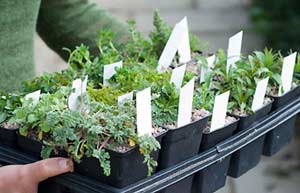
Many plants are imported and although controls are strict, plants can carry pests and diseases or can be invasive. Before you go to the garden centre find out more about plant provenance issues.
Many plants are imported and although controls are strict, plants can carry pests and diseases or can be invasive. Before you go to the garden centre find out more about plant provenance issues.
You've just bought a young English oak tree and are looking forward to watching it develop into a native heirloom. But unless your supplier has guaranteed that it has been grown from British stock, the chances are that the acorns have been collected in Poland or Hungary, it has been grown on in Holland and Belgium and then imported to the UK where it's sold simply as 'English Oak'. You won't necessarily notice any difference when you buy it, but as it originates from a country with colder winters than ours, it's genetically different. It will most likely come into leaf and flower earlier than the native specimens do, and this will have a knock-on effect on the wildlife that use the tree, altering the ecological balance of where it's growing.
"The English Oak is part of our plant heritage," says Jon Rose of Botanica nursery, "and I'm interested in making sure it survives. The trees grown from British stock are heavier branched, will establish better and have better growth rate. This applies to ornamentals too. Big specimens from countries like Italy and Spain are much more susceptible to root death, and there's an increased risk of them harbouring non-indigenous diseases which can spread to the plants growing here."
Imported plants are controlled: all growers supplying to EEC countries must have a Plant Passport, which allows the authorities to monitor and trace any problems with plant health. "Standards of inspection are very stringent in the UK, says Guy Barter of the RHS, but in other countries the checking may be more relaxed." Also, it's not possible to check every single plant, so pests and diseases can be inadvertently imported. Diseases such as Dutch Elm, have already done nationwide damage; others such as Sudden Oak Death are gradually spreading. Imported plants, such as Japanese knotweed and Himalayan balsam, can also become invasive, eventually pushing out native species and altering habitats. Some imported plants, such as tree ferns, cyclamens and orchids, may also have been dug up from the wild.
Many of the plants we buy have been raised in European countries such as Holland, France, Italy, Belgium and Germany, but an increasing number are being grown further afield in countries such as China or, as in the case of Japanese acers which are propagated in China, flown to Holland to be grown on and transported to Italy to mature, being moved between several countries and across continents before they reach the UK. The carbon footprint of these plants hasn't yet been calculated but is certainly considerable and could be avoided by sourcing British or locally grown plants.
Research by the South East England Development Agency shows that people who buy plants in garden centres show little interest in a plant's country of origin. Nurseryman Bill Godfrey believes they would if they realised the key advantages of buying home-grown plants: plants that will grow better, fewer plant miles from the grower to your garden, and support for jobs in the UK horticulture industry.
Guy Barter, Chief Advisor, RHS. "In an ideal world we wouldn't have plant material being brought into this country, just seeds or micro-propagated material. But plants are part of the global economy and if we clamped down on imports, the price of plants would go up. Nurseries need to source their plants very carefully and because plant health inspections and documents cannot be 100 per cent reliable, closely monitor their stock for unusual pests and diseases. We've seen what's happened to our elms, and so far we've been lucky that blights like Sudden Oak Death haven't been as devastating here as Phytophthora root disease has been in Australia."
Andrew Fisher Tomlin, Director, London College of Garden Design. "We should all be thinking about the distance some of our plants travel and ask ourselves do we really need plants that have come from half way round the world. By buying plants that are grown locally, or at least in the UK, we might have difficulty getting certain varieties or some of the exotics. But we produce so many good plants in this country, many of them exotics, that I feel we should make the effort to source them locally and save all those plant miles."

BBC © 2014The BBC is not responsible for the content of external sites. Read more.
This page is best viewed in an up-to-date web browser with style sheets (CSS) enabled. While you will be able to view the content of this page in your current browser, you will not be able to get the full visual experience. Please consider upgrading your browser software or enabling style sheets (CSS) if you are able to do so.

