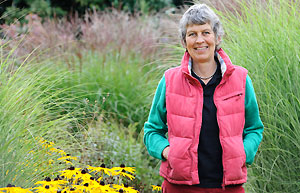
Pauline Pears
How long have you been gardening organically?
I took up gardening in my thirties. I was an organic gardener by default, partly because I was too stingy to buy anything, but I couldn't see a reason to not be. I joined the organisation when it was very way out and whacky, before it found a permanent home at Ryton. My main reason today for continuing to garden organically is because of the environmental benefits - I can't save a whale, or the planet, but in my own garden, I can do good things. And if we all do that, it might have some effect.
What are the key advantages of the organic approach?
It's a system of gardening for everybody - you don't have to worry about your children using things that they shouldn't. And I like to know that the food I'm eating isn't sprayed - I'd rather have greenfly than chemicals. Also, for me, it adds another dimension to gardening - I find composting as interesting as growing carrots! And I'm a very messy gardener, so wildlife has a good time in my garden. Every so often I come across a frog, a toad or a butterfly and think: that's because of what I've done.
What are the cornerstones of organic gardening?
In many ways, organic gardening is simply good gardening – and it's about having a range of strategies, not a quick fix. One of the most vital things is suiting what you plant to your growing situation. If you give the plant what it needs in the soil and the right situation as far as light and shade, then it will grow. The right conditions are key. If needs be, you can improve your soil via composting, but while you can alter the soil to some extent, there's no point in trying to dramatically alter an alkaline soil to grow rhododendrons. It's about making the most of what you've got.
The other key point is to remember that plants are living things and they will suffer from diseases - you need to have a relaxed attitude, but try to create a garden environment with opportunities for predators too. They are always working while you're not.
What organic approaches can gardeners take regarding common pest and disease problems such as lily beetle and tomato and potato blight?
With something like lily beetle, if it's a persistent problem, year after year, stop growing lilies! If you can't bear to do that, then grow them in pots close to the house where you can keep an eye on them and pick off the bugs as you see them.
Tomato blight is an interesting one because commercial tomatoes are grown indoors, so there hasn't been a push to develop blight-resistant tomatoes. Growing them indoors helps because you have a better chance of the fruit ripening before the blight comes. With potato blight, the best approach is to grow earlies and second early varieties, so that as soon as the blight comes, you can just chop the tops of the plants off. You may not get fifty tonnes, but you do get a crop. There are resistant varieties, but the problem is that blight is changing dramatically, so you can't rely on them totally.
The other approach is to try growing different things - the Incas used to grow 60 varieties of potatoes in a field because something would always succeed.
What plants would you recommend to new organic gardeners?
One of my successes this year has been the purple French climbing bean "Kew Blue" from the Heritage seed Library. It's good for drying as well as eating the pods. I like climbing beans because you can start them off in pots and they grow up and away from slugs quite quickly. The purple beans also look great and you can see them much more easily than the green ones! And I wouldn't be without pumpkin 'Crown Prince'. It's the most reliable cropper in this country, the plants themselves are magnificent and it keeps me in pumpkins right through until April. A good ornamental choice is grasses as they’re easy to look after.