
Use your garden to help your children increase their understanding of wildlife. By catching and drawing insects they can look closely at the basic structure of these creatures and build their vocabulary by describing them.
Use your garden to help your children increase their understanding of wildlife. By catching and drawing insects they can look closely at the basic structure of these creatures and build their vocabulary by describing them.
About 20 minutes to an hour, depending on childrens' ages.
1 Help your children to prepare boxes for the insects by putting some damp soil or compost in the bottom and adding a stone or two.
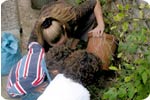 2 Go into your garden and help your children find some insects. They like to hide in cool, damp places. Let the children move stones, look in the compost bin and examine flowers, leaves and the soil.
3 Your children can collect them carefully by using a piece of card to pick them up.
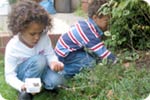 4 They need to put them in the plastic boxes, but should try not to mix the different sorts, just in case they eat each other!
5 Give your children a magnifying glass to watch what the bugs do.
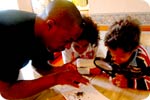 They can put them on a clean piece of paper if they want to look more closely at them. How many legs do they have? What colours are they? Do they have any patterns on them? What do their faces look like? How do they defend themselves?
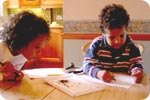 6 Now they can either put the bugs back in the garden, or draw one or more of the insects on the paper. Tell them to make their picture nice and big, putting their name and the date on the bottom of it.
7 When they have finished drawing, remind the children to put the insects back where they found them.
Some bugs can bite (for example, red ants and mosquitoes). Others are reputed to bite but do not usually do so (for example, earwigs and shield bugs)
There is no need to put holes in the lids of the insect pots, particularly as the children will be releasing the insects after the drawing activity.
Common garden bugs that they may find:
Try not to catch bees and wasps. Many flies and hoverflies mimic these as a way of keeping safe. These are good insects to get to know because you can observe them without the risk of getting stung. Help children to use felt pens carefully; they can give vibrant and precise lines, but they can be too wet and heavy to use for effective colouring.
If your children are interested in identifying their insects, or finding out more about them, the Collins Guide to the Insects of Britain and Western Europe is an excellent reference book.

BBC © 2014The BBC is not responsible for the content of external sites. Read more.
This page is best viewed in an up-to-date web browser with style sheets (CSS) enabled. While you will be able to view the content of this page in your current browser, you will not be able to get the full visual experience. Please consider upgrading your browser software or enabling style sheets (CSS) if you are able to do so.

