
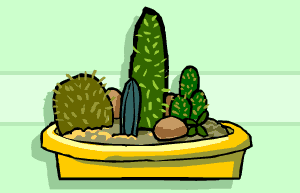
Cacti are a sort of succulent, but a succulent is not always a cactus. Find out more about this tropical plant and discover some amazing facts.
Cacti are a sort of succulent, but a succulent is not always a cactus. Find out more about this tropical plant and discover some amazing facts.
Cacti and succulents have adapted to grow where there is not much fresh water, in places like deserts. Deserts get very little rain, are very hot during the daytime and often frosty at night. A prickly cactus stops birds and animals trying to eat them for their water!
Most plants get rid of litres of water every day, by a process called transpiration, giving out water through their leaves (a bit like when we sweat!). Cactus leaves have become a lot smaller so they don't lose so much water; most have shrunk to spines or hairs but some have disappeared altogether!
The stems are green to make food for the plant, because the leaves can't do it any more - they are too small.
 Cacti stems and ridges expand to store lots of water when it rains. Think of a camel that stores food in his hump! This guides as much rain as possible to the roots. Some cacti and succulents have swollen roots that store up water for the days when it doesn't rain; sometimes in the desert it doesn't rain for months.
Leaf succulents store water in their leaves. Their leaves can take different forms as a means of protection from drying out. They can be:
Many of these plants wait until it rains to flower. Rain also makes their seeds germinate and these seeds can stay dormant for a long time in the soil.
The giant saguaro cactus is:
The prickly pear cactus has a big network of shallow roots, which can quickly soak up lots of water when it rains.
The ocotillo plant only grows leaves after it has rained - as soon as the soil dries out, they all drop off.
Some cacti spines are nearly 15cm (6in) long.
Boerhavia repens is a desert plant which can germinate, grow, produce flowers and ripen seeds in the space of ten days after it has rained.
The century plant takes 25 years to grow a flower. Then it dies. Lots of agaves do this!
Pebble plants (Lithops species) only have two leaves, and they look like the pebbles on the ground next to the plant. Their beautiful flower grows between the leaves.
Some species of agave plants (succulents not cacti) are also called Needle and Thread plants because the spiny tip and stringy leaf margin can be broken off and used to sew - and are even strong enough to sew through leather.
The spines of the Barrel cactus were used by local people for fishing hooks.
Look at a cactus or a succulent. It is a true cactus if it has a little ring of hair or fluff where the spines come out; are you looking at a cactus or a succulent? Or create your own cactus garden with our home-grown project.

BBC © 2014The BBC is not responsible for the content of external sites. Read more.
This page is best viewed in an up-to-date web browser with style sheets (CSS) enabled. While you will be able to view the content of this page in your current browser, you will not be able to get the full visual experience. Please consider upgrading your browser software or enabling style sheets (CSS) if you are able to do so.

