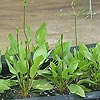
Alisma plantago-aquatica var. parviflora Water plantain
This alisma is perhaps the prettiest of the water plantains. It is an uncommon plant for the water's edge with broad leaves and bearing loose panicles of white flowers from June until September. It requires an open sunny position in mud or up to 25cm depth of water. This plant is quite free-flowering once established. They will often spread by self-seeding, provided the flower heads are not removed once they have faded. Plants may be propagated by division in spring or by seed in late summer.
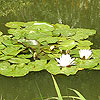
Nymphaea alba Water lily
This is a big spreading water lily with star-like, pure white flowers about 15cm wide, and distinctive yellow stamens. It needs to be planted in a large aquatic basket filled with aquatic soil, with the sausage-like stem (or rhizome) going just under the surface. Put gravel over the top. The container then goes about 20cm under the water surface, possibly supported on an old brick. Only buy it if you have a large, still pond (avoid running water) in full sun, which will not be choked by its growth. If you have a pond with running water, choose a Nuphar lily instead.
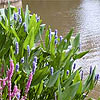
Pontederia cordata Pickerel weed
This is a glorious water plant, not least for its conspicuous tight spikes of blue flowers towards the end of the season. It is a North American native, naturally colonising large areas of swamps, and the plants are happiest where they can spread freely in marginal mud. To confine their spread they are best planted in baskets, but make sure they are covered by 23-30cm (9-12in) of water in cold districts to ensure their safety from frost. They also grow well in bog gardens, but should be mulched for protection in early winter. The Royal Horticultural Society has given it its prestigious Award of Garden Merit.
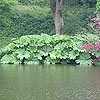
Gunnera manicata Gunnera
Gunnera is one of the biggest and most spectacular, architectural, herbaceous plants, commonly thought of as 'giant rhubarb'. The plants need a lot of space because it is difficult to restrict their size. They look best as specimen plants in a damp bog garden, or beside a large pond where the reflections reveal the prickly undersides of the leaves. The fat growth buds clustered in the crown are prone to frost damage, so pile the dead leaves and stems into a mound over the plants in autumn for winter protection - they make quite a feature of their own. The Royal Horticultural Society has given it its prestigious Award of Garden Merit.
Arundo donax 'Variegata' Arundo
A tall growing ornamental grass that will add an architectural touch to any planting scheme. Plants spread by underground rhizomes forming attractive leafy clumps that will make a bold statement at the back of border. The variety 'Variegata' has a broad yellow stripe along its leaves. Variegated forms are more tender than the plain green ones so plant in a sheltered spot away from strong winds. The flowers which appear in late autumn are purplish green and remain on the plant once growth dies back.
To view the panoramic image, click on the garden with your mouse and drag it around the picture. To find out about the planting hotspots in the garden, click on the leaf icon above. To start and stop the audio commentary click on the speaker icon.
If you're having problems viewing the panoramic images read our help page. Alternatively, take a look at our still photography of all of the show gardens.
"My intent is to create a magical place to escape the hurly burly of life, whatever weather the Great British Summer throws at us. The expanse of water calms the soul while the timber building, inspired by the dreamy beach cabanas of Belize, makes an ideal hideaway to enjoy either in the company of friends or to relax in isolation and contemplation."
Pete Sims - designer of the Come Rain or Shine garden
Discover which garden the public voted their favourite in this year's BBC RHS People's Award.










 "My intent is to create a magical place to escape the hurly burly of life, whatever weather the Great British Summer throws at us. The expanse of water calms the soul while the timber building, inspired by the dreamy beach cabanas of Belize, makes an ideal hideaway to enjoy either in the company of friends or to relax in isolation and contemplation."


