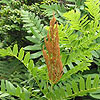
The flowering fern is a large plant which needs room to develop. The large clumps have tall stems bearing short ladder-like leaves along their length. In summer, spore-bearing fronds with tightly furled tips push up through the leaves, creating an impression of faded flower-heads, hence the plant's common name. In autumn, the foliage turns golden yellow don't cut it down until winter's end. Although ferns are traditionally grown in shade, this one is happy in sun provided the soil stays moist. The Royal Horticultural Society has given it its prestigious Award of Garden Merit (AGM).
Filipendula rubra 'Venusta' Queen of the prairies
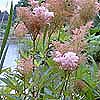
An attractive, spreading plant for damp soil and boggy areas. The large, deeply cut leaves are fresh green and the flower spikes, which appear from early to mid-summer, are dark rose-pink becoming paler with age. The Royal Horticultural Society have given it the Award of Garden Merit (AGM).
Rodgersia aesculifolia Rodgersia
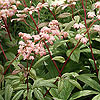
With 25cm long, bronze-tinted leaves like huge hands with brown veins, this Chinese perennial has great presence, and it's even more striking in midsummer. The clusters of creamy white to creamy pink flowers form loose pyramids on tall stems, and are beautiful. The seed-heads have a reddish tint in autumn. It makes a great show in a damp part of the border or bog garden where it can produce highly impressive clumps. It has been given the Award of Garden Merit by the RHS.
Gunnera manicata Gunnera
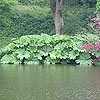
Gunnera is one of the biggest and most spectacular, architectural, herbaceous plants, commonly thought of as 'giant rhubarb'. The plants need a lot of space because it is difficult to restrict their size. They look best as specimen plants in a damp bog garden, or beside a large pond where the reflections reveal the prickly undersides of the leaves. The fat growth buds clustered in the crown are prone to frost damage, so pile the dead leaves and stems into a mound over the plants in autumn for winter protection - they make quite a feature of their own. The Royal Horticultural Society has given it its prestigious Award of Garden Merit.
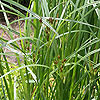
Cyperus longus Galingale
This is a dual-purpose perennial, which can be grown at the edge of a pond, in water up to 15cm deep, or in bog gardens or damp borders. It sends up attractive tall, thin, arching, rich green leaves and, in late summer, there are contrasting reddish-brown spikelets. If growing in water, restrict its spread by keeping it in a basket because, unlike other kinds of Cyperus, it will run and run.
To view the panoramic image, click on the garden with your mouse and drag it around the picture. To find out about the planting hotspots in the garden, click on the leaf icon above. To start and stop the audio commentary click on the speaker icon.
If you're having problems viewing the panoramic images read our help page. Alternatively, take a look at our still photography of all of the show gardens.
"The purpose of the garden is to recreate the feeling of a simpler time when the pace of life was slower and our connection to nature was far greater than today. A time when we could eat fish fresh from the stream and the honey on our bread was gathered from our own apiaries. The garden represents the relaxing ambience of a Sunday afternoon spent playing on the lawn, laying on your back gazing at the trees or sitting and fishing in the stream."
Tim Sharples - designer of The Riverside Folly garden
Discover which garden the public voted their favourite in this year's BBC RHS People's Award.









 "The purpose of the garden is to recreate the feeling of a simpler time when the pace of life was slower and our connection to nature was far greater than today. A time when we could eat fish fresh from the stream and the honey on our bread was gathered from our own apiaries. The garden represents the relaxing ambience of a Sunday afternoon spent playing on the lawn, laying on your back gazing at the trees or sitting and fishing in the stream."


