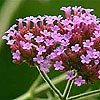
Tall, narrow, sparsely-leafed stems bear flattened heads of bright lavender-purple flowers that provide useful height in a herbaceous border. This is a short-lived perennial, and because it is borderline hardy, plants may be damaged by winter frosts. This may be avoided by leaving the dead stalks until spring, when new growth is evident, before cutting them back. A protective mulch should be added around them in the autumn with leaf mould or compost. They do, however, self-seed liberally and resulting seedlings are stronger and more drought-tolerant than those that are transplanted. This is a superb butterfly plant, rivalling even buddleja. The Royal Horticultural Society have given it the Award of Garden Merit.
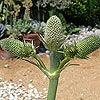
Eryngium agavifolium Sea holly
The sea holly is a bold evergreen with an upright stem topped by greenish-white late summer flowers high above wide, spine edged, deep green leaves at the base. It thrives in well-drained soil, prefers full sun and hates having its roots locked in wet winter soil. Keep away from a border edge where the sharp spines might scratch passers-by.
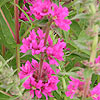
Lythrum salicaria 'Feuerkerze' Loosestrife
A long-flowering plant with a strong presence, useful for late summer and early autumn, 'Feuerkerze' is ideal for growing in boggy soil by a pond or stream. It sends up slender stems laden with vibrant, rose-red flowers. Divide every few years to keep it under control. It is the only loosestrife to have been given the Award of Garden Merit by the RHS and should not be confused with lysimachia, which has the same common name.
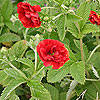
Potentilla 'Arc-en-ciel' Cinquefoil
Highly effective at the front of a border where its floppy, trailing stems make good ground cover the 'Arc-en-ciel' stands out thanks to the large, dark red flowers with a flash of yellow at the edge. The main flowering period is June, July and August, but the moment it stops, cut it right back to get a second flush of leaves and buds. The ground must be free-draining or it won't survive winters in damp, cold soil. Can also be grown in rock or gravel gardens or containers.
Ballota pseudodictamnus False dittany
Ballota is a small genus which includes a few dwarf shrubs or subshrubs, almost border perennials in appearance and originating mainly in Greece and the eastern Mediterranean. This species is a neat and attractive foliage plant, evergreen except in cold exposed positions, and a fine choice for hot sunny sites where it forms tidy mounds of ground-cover foliage. The whole plant is woolly, a beautiful greyish white on its younger growth, which is usually encouraged by firm annual pruning. Propagate by semi-ripe cuttings in summer. A hardy shrub, ballota can grow in most soils that are free-draining, but prefers a sunny site, and will tolerate drought. On damp cold sites, mulch with bark over winter. The Royal Horticultural Society has given it its prestigious Award of Garden Merit.
To view the panoramic image, click on the garden with your mouse and drag it around the picture. To find out about the planting hotspots in the garden, click on the leaf icon above. To start and stop the audio commentary click on the speaker icon.
If you're having problems viewing the panoramic images read our help page. Alternatively, take a look at our still photography of all of the show gardens.
"My cottage garden has a hint of reflection on the past but with a modern slant. It's a garden that utilizes stone mulches to help water conservation. I would like people to find the garden something that they can achieve at home."
Rosy Hardy - designer of the Daily Mail Cottage Garden
Discover which garden the public voted their favourite in this year's BBC RHS People's Award.









 "My cottage garden has a hint of reflection on the past but with a modern slant. It's a garden that utilizes stone mulches to help water conservation. I would like people to find the garden something that they can achieve at home."


