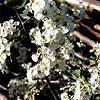
The thorny stems of hawthorn make it an ideal boundary hedge that will help keep unwelcome visitors out of the garden. This deciduous tree produces fragrant white flowers in late spring, followed by glossy dark red fruit. Trained as a hedge it will reach between 1.5 and 3m (5-10ft) in height. If grown as a formal hedge, it will need to be pruned twice a year, in summer and autumn. Grown as an informal hedge, the only pruning needed is the removal of the most vigorous shoots in winter.
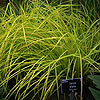
Carex elata 'Aurea' Bowles' golden sedge
A delightful dwarf sedge forming compact tufts of arching, dark green leaves, each edged with white, which give the plants a considerable sparkle. Plants look good grown towards the front of a moist border or among other plants, especially compact perennials and grasses, since they tolerate light shade. However they also look good grown at the edge of a pond, and are a useful solution to the problem of what to plant as a marginal that looks authentic but will grow in normal border soil instead of needing wet bog garden conditions. The Royal Horticultural Society has given it its prestigious Award of Garden Merit (AGM).
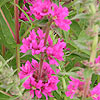
Lythrum salicaria Purple loosestrife
Purple loosestrife makes a tall wildflower that grows naturally on banks of streams and around ponds. It has strong, upright stems, topped in summer with long, poker-like heads of bright purple-red flowers. Plants look tidier if dead heads are removed occasionally. They do not need staking but, because plants can be rather vigorous, they need dividing every few years to keep within bounds. Team with other moisture-loving plants such as inula in a damp border or pondside.
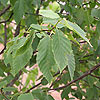
Betula lenta Cherry birch
This is one of the best birches from eastern North America because of its yellow-green summer leaves that turn golden yellow in the autumn, and dark, red brown bark on a slender stem. The yellowish-brown catkins appear during early spring, and dangle from the upward-pointing branches. Once planted, there's little else to do, but make sure that the immediate area is weed-free, and if planting in a lawn keep the grass away to avoid damaging the trunk with a strimmer.
Ligularia przewalskii Ligularia
An attractive choice for a sunny spot in moist soil, this hardy perennial from North China is grown for its tall stems of yellow flowers which appear from mid- to late summer. Its foliage is also very attractive, with deeply cut edges. Shelter from strong winds to avoid the flower stems breaking off. To propagate, divide plants in spring. The Royal Horticultural Society have given it their prestigious Award of Garden Merit.
To view the panoramic image, click on the garden with your mouse and drag it around the picture. To find out about the planting hotspots in the garden, click on the leaf icon above. To start and stop the audio commentary click on the speaker icon.
If you're having problems viewing the panoramic images read our help page. Alternatively, take a look at our still photography of all of the show gardens.
"The garden echoes the ambience and character of the chalk streams of the Test Valley in Hampshire. It recreates a semi-naturalistic landscape for relaxing and fishing for trout. A contemporary sculpture entitled Melusina depicts the spirit of water emerging. It's the gentle voice of Melusina that reminds us when it's time to replenish the coffers of the soul. I feel it encourages us to take solace from within."
Sarah Eberle - designer of A Fisherman's Retreat
Discover which garden the public voted their favourite in this year's BBC RHS People's Award.









 "The garden echoes the ambience and character of the chalk streams of the Test Valley in Hampshire. It recreates a semi-naturalistic landscape for relaxing and fishing for trout. A contemporary sculpture entitled Melusina depicts the spirit of water emerging. It's the gentle voice of Melusina that reminds us when it's time to replenish the coffers of the soul. I feel it encourages us to take solace from within."


