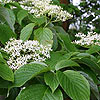
A deciduous tree from Japan and Korea with branches growing in tiers which earns it the nickname of wedding-cake tree. From May onwards it will be covered in star-shaped white flowers and in autumn the bright green leaves turn purple in autumn and round, black fruits appear.
Cynara cardunculus Cardoon
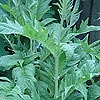
An old Victorian favourite, once grown as a vegetable and blanched for use rather like celery, the cardoon is now valued for its striking silvery, thistle-like foliage which adds a theatrical touch to the border. In summer, tall flower stems are topped by fat thistle buds which resemble small globe artichokes - the plants are close cousins. The buds finally open into large purple thistles which attract lots of bees; the dead flower-heads can be left on the plants and will provide an attractive feature over the winter months. The Royal Horticultural Society have given it the Award of Garden Merit (AGM).
Euphorbia griffithii 'Fireglow' Spurge
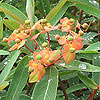
A dramatic plant with attractive dark green foliage, each leaf with a reddish midrib, making plants striking all season. The plant itself is tall and bushy, with spreading rhizomatous roots, while the flowers are its glory, bright fiery brick red and fairly long-lasting. Plants are particularly good in hot schemes and dry sunny borders, but also combine well with yellow flowers and gold variegated foliage in the early summer border. Plants are fairly drought-tolerant and need little attention.
Aquilegia vulgaris var. stellata 'Black Barlow' Granny's bonnet
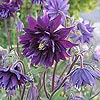
Popular for its late spring and early summer dark plum-purple flowers, it makes a stronger show than the more well-known 'Nora Barlow' which has much paler, pinker colours. 'Black Barlow' makes an effective contrast with white alliums and white sweet rocket, and other aquilegias such as the purple and white 'Colorado' and the red and gold 'Kansas'. It likes moist but free-draining soil where it will self-seed prolifically. You can either collect the ripe black seed in the early autumn and sow it in pots in cold frames, or gently move the young self-sown plants in the garden to more favourable positions in the spring. It's possible to divide cultivars in the spring, but they sulk for quite a while until they have fully recovered.
Salvia nemorosa 'Caradonna' Salvia
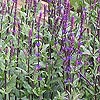
This new plant is attracting plenty of attention because of its dark striking stems topped by violet flowers from early to midsummer. Unlike many salvias it is perfectly hardy, its species parent being a native of central Europe and western Asia, and one of the first salvias grown in the UK. The leaves of both the species and 'Caraddona' are about 3cm long and half as wide, and finely toothed. It can either be grown amongst other upright plants, or be used to contrast with more angular, architectural groupings.
To view the panoramic image, click on the garden with your mouse and drag it around the picture. To find out about the planting hotspots in the garden, click on the leaf icon. To watch a video about the architectural features in the garden, click on the arrow icon.
If you're having problems viewing the panoramic images, take a look at our still photography of all of the show gardens.
"The garden is inspired by the Cancer Research UK message 'Together we will beat cancer'. Focusing on the word 'together', the garden has been designed so that all the various elements; hedges, paths, benches and so on are all interlinked and lock together. The paths from either end also draw people together into the heart of the garden and the modern amphitheatre then provides a place to sit together. But the most dramatic aspect of the garden is a 30 metre long sculpture which consists of five strands of curved oak ribbons which weave together and wind through the garden linking all the different elements."









 Watch a video tour
 Download a takeaway plan
 "The garden is inspired by the Cancer Research UK message 'Together we will beat cancer'. Focusing on the word 'together', the garden has been designed so that all the various elements; hedges, paths, benches and so on are all interlinked and lock together. The paths from either end also draw people together into the heart of the garden and the modern amphitheatre then provides a place to sit together. But the most dramatic aspect of the garden is a 30 metre long sculpture which consists of five strands of curved oak ribbons which weave together and wind through the garden linking all the different elements."


