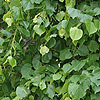
This vigorous tree has a pyramidal habit, and can reach 30m in height. It's large leaves are heart-shaped and sharply toothed, with bluish-green undersides. The flattened clusters of pale yellow flowers hang from reddish-brown twigs, giving off a strong perfume in summer.
Carpinus betulus 'Fastigiata' Hornbeam
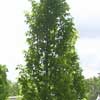
This handsome tree was introduced about a century ago and has been extensively planted in streets and parks. Neater and denser than the simple species, it grows quite fast while young, producing a neat formal shape, almost triangular in silhouette. The leaves are brighter and shinier than the species, and turn rich yellow and orange shades in autumn, often remaining on young trees all winter before falling. A specimen tree that is useful as a focal point in larger gardens. The Royal Horticultural Society has given it its prestigious Award of Garden Merit (AGM).
Liquidambar styraciflua Sweet gum
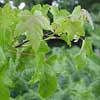
This handsome tree from Eastern USA and Mexico produces fantastic autumn colours of orange, red and purple. For the best display, grow in full sun, however it will tolerate partial shade. The common name of sweet gum comes from the resin-like scent that its leaves produce when crushed. Young shoots often have distinctive corky ridges. It makes a beautiful tree for woodland plantings or as a specimen. Grow in neutral to acid soil that is moist but well-drained. To propagate sow seeds in pots in a cold frame in autumn.
Cynara cardunculus Cardoon
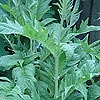
An old Victorian favourite, once grown as a vegetable and blanched for use rather like celery, the cardoon is now valued for its striking silvery, thistle-like foliage which adds a theatrical touch to the border. In summer, tall flower stems are topped by fat thistle buds which resemble small globe artichokes - the plants are close cousins. The buds finally open into large purple thistles which attract lots of bees; the dead flower-heads can be left on the plants and will provide an attractive feature over the winter months. The Royal Horticultural Society have given it the Award of Garden Merit (AGM).
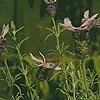
Lavandula stoechas French lavender
An attractive and unusual lavender from hot, dry Mediterranean regions, and best grown in a warm position, sheltered from cold winds and frost. It is not fully hardy, but survives well in a sunny corner or against a warm wall, and makes an excellent container plant that can be brought under cover in winter. It is an old variety, cultivated for more than 400 years, and a favourite both for its intense fragrance and also the short dense flower spikes topped with a flourish of conspicuous rich violet bracts, rather like a set of extravagant ears. The Royal Horticultural Society has given it its prestigious Award of Garden Merit (AGM).
To view the panoramic image, click on the garden with your mouse and drag it around the picture. To find out about the planting hotspots in the garden, click on the leaf icon. To watch a video about the architectural features in the garden, click on the arrow icon.
If you're having problems viewing the panoramic images, take a look at our still photography of all of the show gardens.
"The garden is a celebration of Fortnum & Mason's tercentenary, and has been designed to communicate Fortnum's spirit of entertainment and indulgence, blended together with wit, quality and history.
"Historic references include three shell and pebble grottoes that relate to Fortnum's Georgian heritage and love of collecting. Stylish furniture on the paved terrace communicates the idea of entertainment and outdoor living, while a contemporary hardwood and wicker fence conjures the image of Fortnum's famous hampers. Four 'Fortnum's beehives' are included as ornamental features, together with drifts of planting attractive to bees. The planting is designed to create a sumptuous 'tapestry' of rich colours and texture dominated by red, purple, pink and pale yellow."









 Watch a video tour
 "The garden is a celebration of Fortnum & Mason's tercentenary, and has been designed to communicate Fortnum's spirit of entertainment and indulgence, blended together with wit, quality and history.


