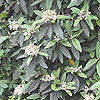
Introduced by Ernest Wilson from China in 1900, it is one of the bigger, beefier viburnums and quickly shoots up, making an excellent, semi-evergreen hedge. The leaves are dark green and glossy on top, and greyish beneath, and the small white flowers open in late spring, being followed by red fruit which gradually turns shiny black. Highly impressive and widely available.
Anemanthele lessoniana Pheasant's tail grass
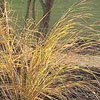
In summer this grass is streaked orange-brown and it then turns to orange brown all over in winter, when there may be less to catch your eye in the garden. The narrow, flat or inrolled leaves are dark green the rest of the year. It has a pleasing overall arching habit with interesting purple-green flower spikelets that hang down, almost touching the ground, from midsummer to early autumn. The seed-heads that follow provide a winter food source for finches and other seed-eating birds. Don't be put off growing it if you have a heavy soil. Plants may need winter prtection in colder gardens. To propagate, divide plants from mid-spring to early summer.
Geranium 'Philippe Vapelle' Hardy geranium
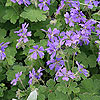
'Philippe Vapelle' is one of the hundreds of hardy geraniums that Orkney farmer, Alan Bremner has raised in his garden. It produces purple flowers with dark veins all summer long and makes a neat, mound-shaped plant. Hardy geraniums are ideal for adding an informal touch to cottage gardens and are great for adding colour to shady spots in the garden.
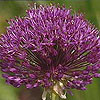
The tall flowers of 'Purple Sensation' appear in summer, showing off rounded heads full of deep violet flowers. These alliums are perfect for a sunny border. It is best to remove the immature seed-heads as the seedlings tend to have paler flowers. The Royal Horticultural Society has given it its prestigious Award of Garden Merit (AGM) in recognition of its outstanding excellence.
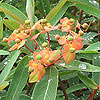
Euphorbia griffithii 'Fireglow' Spurge
A dramatic plant with attractive dark green foliage, each leaf with a reddish midrib, making plants striking all season. The plant itself is tall and bushy, with spreading rhizomatous roots, while the flowers are its glory, bright fiery brick red and fairly long-lasting. Plants are particularly good in hot schemes and dry sunny borders, but also combine well with yellow flowers and gold variegated foliage in the early summer border. Plants are fairly drought-tolerant and need little attention.
To view the panoramic image, click on the garden with your mouse and drag it around the picture. To find out about the planting hotspots in the garden, click on the leaf icon. To watch a video about the architectural features in the garden, click on the arrow icon.
If you're having problems viewing the panoramic images, take a look at our still photography of all of the show gardens.
"This garden is a study in contrast between simplicity and complexity. It contrasts a minimal asymmetric plan with materials, surfaces and planting of rich patina and texture. The garden is enclosed by alternating sections of hornbeam hedge and a pre-rusted steel wall, which dictates the colour theme that runs through the garden.
"The aim is to make a garden where texture and process are to the fore, where it's not just the plants that are changing with time, but the whole composition becomes a perishable, changing thing."
Tom Stuart Smith - designer of The Daily Telegraph Garden
Vote now for your favourite garden in the BBC RHS People's Award.










 "This garden is a study in contrast between simplicity and complexity. It contrasts a minimal asymmetric plan with materials, surfaces and planting of rich patina and texture. The garden is enclosed by alternating sections of hornbeam hedge and a pre-rusted steel wall, which dictates the colour theme that runs through the garden.


