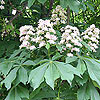
A superb tree with lots of advantages. It will grow in any soil, is absolutely huge, and has wonderful white flowers at the end of spring, running into early summer, when it is definitely at its best. The flowers are followed by masses of conkers inside their spiny shells. There are alternatives but this species is still the best, and it has been given the Award of Garden Merit (AGM) by the Royal Horticultural Society.
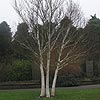
Betula utilis var. jacquemontii 'Silver Shadow' Kashmir birch
This variety is also known as the Kashmir birch, and is one of the loveliest with its intensely white bark. Some plants have cream or orange bark, which sheds itself in large sheets. To be sure of good colour, it is best to choose one of the selected forms such as 'Silver Shadow'. It is an exceptionally beautiful specimen tree, even more impressive when several are planted close together to make a small clump, and stands out against a foil of dark green woodland or evergreen hedging. In autumn the foliage is vivid yellow. It prefers a sunny or slightly dappled position, growing in fertile, well-drained soil.
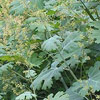
Macleaya cordata Plume poppy
Holder of the Royal Horticultural Society's prestigious Award of Garden Merit (AGM), the Plume poppy is a striking architectural plant, with tall upright stems and attractive grey to olive-green, lacy foliage. In summer, the stems are topped by long airy sprays of buff white flowers. Plants are slow to get going and often barely grow in their first season but, once established, they can spread quite rapidly. If space permits, plants look best when allowed to develop freely into large clumps, especially when used as a feature in the same way as pampas grass.
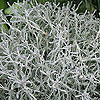
Santolina incana Cotton lavender
This neat, dwarf, clump-forming shrub is ideal for smaller gardens or as a low-growing hedge. It has deeply-toothed, slightly woolly, aromatic silver leaves on white felted branches which are soft to the touch. Do not prune the shrub until after July, as its bright lemon-yellow pompon flowers add a wonderful splash of colour through the latter summer months. Once the plant has flowered, don't be afraid to cut it back fairly hard to keep it in good shape. It's not a particularly demanding plant but, as with all plants of Mediterranean origin, it needs a sunny position in well drained soil.
Onopordum acanthium Scotch thistle
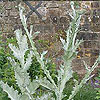
The tall statuesque stems of this native Scotch thistle are clad in silvery spiny foliage and topped with a huge pink thistle. It is best planted at the back of a border as it can reach around 3m (10ft). Although it is a biennial, it self-seeds freely and so plants appear each year. Plant in any fertile, well-drained, slightly acidic soil in full sun. This plant is perfect for a sunny gravel or wildlife garden.
To view the panoramic image, click on the garden with your mouse and drag it around the picture. To find out about the planting hotspots in the garden, click on the leaf icon. To watch a video about the architectural features in the garden, click on the arrow icon.
If you're having problems viewing the panoramic images, take a look at our still photography of all of the show gardens.
"What I love about the Cotswolds is its natural beauty, with the stone seeming to grow out of the ground. So being asked to design the garden for the new Spa at Barnsley House gave me the chance not only to use stone but to combine it with water and the native plants which thrive in the hedgerows and fields.
Stephen Woodhams - designer of The Barnsley House Spa Garden
Vote now for your favourite garden in the BBC RHS People's Award.









 "What I love about the Cotswolds is its natural beauty, with the stone seeming to grow out of the ground. So being asked to design the garden for the new Spa at Barnsley House gave me the chance not only to use stone but to combine it with water and the native plants which thrive in the hedgerows and fields.


