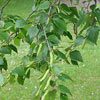
The plain silver or common birch, sometimes called 'the lady of the woods' because of its outstanding elegance, is a great landscape feature, especially in autumn and while still young - older trees can become enormous, but without dominating or shading the garden too much. When planted 60cm (2ft) apart, the trees make a fine hedge, or may be grown 2.4m (8ft) apart as a screen or windbreak, which can be trimmed each winter. Growth is upright, later slightly weeping, especially the young outer stems - trim shoots off the trunk to reveal the attractive bark. The Royal Horticultural Society has given it its prestigious Award of Garden Merit (AGM).
Acacia dealbata Mimosa
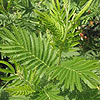
Mimosa makes a beautiful evergreen shrub for the conservatory or greenhouse. In very sheltered areas, it can be grown outdoors. It has silvery leaves which are complemented by long, fragrant yellow flowerheads in winter and spring. The Royal Horticultural Society has given it their prestigious Award of Garden Merit.
Prunus lusitanica Portugal laurel
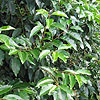
Like its close relative the cherry laurel, this species from Spain and Portugal is usually planted to make a large hedge, screen or windbreak. It is a very beautiful shrub in its own right though, eventually making a large shapely tree if allowed to grow naturally. The leaves are an attractive shade of green, reddish when young and on red stalks, while the white flowers in early summer smell sweetly of hawthorn. It is hardier and more versatile even than cherry laurel, and withstands clipping into formal shapes. The Royal Horticultural Society have given it their Award of Garden Merit (AGM).
Tulipa 'Spring Green' Tulip
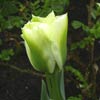
Green flowers have always fascinated gardeners and flower arrangers. With the tendency for tulips to produce bizarre colour breaks, green varieties were inevitable, and there is now a comprehensive selection of strong-stemmed single varieties in various colours and elegant shapes, but all with green bands, edges, flares and other markings. They all flower in May. 'Spring Green' is a supreme arranger's variety with a fresh green ground colour, and a broad white edge at their tips, the petals shade to ivory and soft yellow. The Royal Horticultural Society has given it its prestigious Award of Garden Merit (AGM).
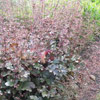
Heuchera 'Chocolate Ruffles' Coral flower
Like all heucheras, this attractive foliage plant makes great ground cover for a sunny or partially shaded spot. As the name suggests, it does have delicious chocolate coloured leaves but it is the underside of the leaf that is richly coloured. It is also more drought tolerant than older varieties.
To view the panoramic image, click on the garden with your mouse and drag it around the picture. To find out about the planting hotspots in the garden, click on the leaf icon. To watch a video about the architectural features in the garden, click on the arrow icon.
If you're having problems viewing the panoramic images, take a look at our still photography of all of the show gardens.
"Wearing the hat of architect and garden designer, I've produced a design to show how a house interior can be connected to a compact garden space through a well-designed garden room.
"Building a roof terrace above instead of a conservatory, complies with building and thermal regulations, saves substantially on CO2 emissions and absorbs most of the rainfall through the planting on the terrace."
Barry Mayled - designer of The Rockwool Garden Room
Vote now for your favourite garden in the BBC RHS People's Award.









 "Wearing the hat of architect and garden designer, I've produced a design to show how a house interior can be connected to a compact garden space through a well-designed garden room.


