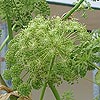
This is a majestic plant that deserves a prominent position at the back of a border or in a wild part of the garden. It loves woodland conditions, with plenty of moist shade. All parts of the aromatic plant have culinary or medicinal uses, but it is best known for its candied stems, used as a cake decoration. In their first year, plants produce leafy bushes, and then die down and disappear completely from sight in winter in their second year they reach full size, and if prevented from flowering and seeding can survive for several years.
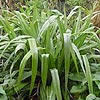
Astelia chathamica Silver spear
Silver Spear is a hardy, clump-forming perennial with elegant, silvery spear-shaped leaves. In very cold winters, in exposed areas, plants may suffer frost damage and will benefit from protection. During mid to late spring, long stalks of yellowish-green flowers emerge from female plants, which produce orange berries in summer. This plant can make a dramatic feature in the garden especially when planted close to purple-foliage plants such as Aeonium 'Zwartkop', or Phormium 'All Black'. It makes an unusual alternative to New Zealand flax. Propagate by division in spring.
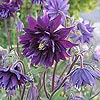
Aquilegia vulgaris var. stellata 'Black Barlow' Granny's bonnet
Popular for its late spring and early summer dark plum-purple flowers, it makes a stronger show than the more well-known 'Nora Barlow' which has much paler, pinker colours. 'Black Barlow' makes an effective contrast with white alliums and white sweet rocket, and other aquilegias such as the purple and white 'Colorado' and the red and gold 'Kansas'. It likes moist but free-draining soil where it will self-seed prolifically. You can either collect the ripe black seed in the early autumn and sow it in pots in cold frames, or gently move the young self-sown plants in the garden to more favourable positions in the spring. It's possible to divide cultivars in the spring, but they sulk for quite a while until they have fully recovered.
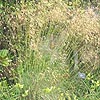
Stipa gigantea Giant feather grass
This is a very striking evergreen grass that forms a spiky clump of arching deep green foliage from which a huge sheaf of very long-stemmed, oat-like flower-heads erupts in mid-summer, up to 1.8m (6ft) high. When mature, these splay apart to make a wide fountain shape that almost hides the plant. The seed-heads dry out naturally on the plant and persist into early winter, where they make a good architectural feature, especially when outlined in frost. This is an excellent alternative to pampas grass as a lawn specimen in small gardens, and perfect in a border or a gravel garden. It is found growing wild in Spain and Portugal. To propagate, divide plants from mid-spring to early summer. The Royal Horticultural Society has given it their prestigious Award of Garden Merit (AGM).
Onopordum acanthium Scotch thistle
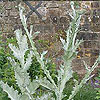
The tall statuesque stems of this native Scotch thistle are clad in silvery spiny foliage and topped with a huge pink thistle. It is best planted at the back of a border as it can reach around 3m (10ft). Although it is a biennial, it self-seeds freely and so plants appear each year. Plant in any fertile, well-drained, slightly acidic soil in full sun. This plant is perfect for a sunny gravel or wildlife garden.
To view the panoramic image, click on the garden with your mouse and drag it around the picture. To find out about the planting hotspots in the garden, click on the leaf icon. To watch a video about the architectural features in the garden, click on the arrow icon.
If you're having problems viewing the panoramic images, take a look at our still photography of all of the show gardens.
"The pavilion was inspired by classic modern art pieces like the Lords Media Centre and the 'Bench bo' seat. The stick screen around the perimeter draws on nature, mimicking the vertical stems of native grasses, with the turquoise swimming pool designed to conjure up images of foreign holidays."
Andy Sturgeon - designer of The Cancer Research UK Garden
Vote now for your favourite garden in the BBC RHS People's Award.









 "The pavilion was inspired by classic modern art pieces like the Lords Media Centre and the 'Bench bo' seat. The stick screen around the perimeter draws on nature, mimicking the vertical stems of native grasses, with the turquoise swimming pool designed to conjure up images of foreign holidays."


