This is a genus of about 20 species of fibrous-rooted, clump-forming evergreen perennials. They are found in moist, grassy areas and scrub in New Zealand, temperate North and South America, eastern Australia and New Guinea. They grow in slow-growing tufts, producing strap-like, veined leaves that turn orange in cooler weather. The plant has small, white star-shaped flowers, similar to an iris. The flowers are followed by glossy, burnt orange seed heads the size of marbles. The plant thrives in moderately fertile, moist but well-drained soil in full sun, although it will also tolerate both drought and poor soil.
Astelia banksii Astelia
A New Zealand native, this species astelia is grown for the tussocks of arching leaves and not for the panicles of small flowers which emerge from the rosette of leaves. Growing up to 2m tall this plant has eye-catching, silver-green, strappy leaves. It grows on rocks and banks as an epiphyte. The greenish flowers are followed by purple fruit which was traditionally eaten by the Maoris.
Metrosideros excelsa Christmas tree, Pohutukawa
From the North island of New Zealand, this is a decent-sized tree that erupts in a blaze of crimson bottlebrush-like flowers in summer. It's common name derives from the fact that Christmas falls during its homeland's summer. The second big attraction is the colour mix of the leaves, dark green on top with a whitish underside. When the wind is whipping them about you get a lovely, mottled effect. The best places to see them growing in the UK are at Tresco, in the Scilly isles, which gives you an idea how tender they are. Only for the warmest, sunniest, most sheltered sites on the mainland.
Celmisia verbascifolia Celmisia
This New Zealand cousin of the aster has the same golden centre and daisy-like white flowers, but it is also blessed with striking silver-green leaves that are slightly furry to the touch. The plant is found all over the country, but particularly in high, mountainous areas where it will cling to rocks and stony outcrops. It's extremely hardy and regularly survives snowy winters in Southern Alps of New Zealand. As an alpine plant, it needs well-draining soil with plenty of grit.
Pseudopanax ferox Toothed lancewood
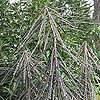
A bizarre, slow-growing evergreen tree from New Zealand, it looks more like the folded spokes of an umbrella attached to a central, slender stem. The vicious leaves (which don't look like leaves at all) are 45cm long and just 1cm wide, often with a coloured stripe down the centre. If you want a large specimen, buy big because a five-year-old will still only be 60cm tall. A good choice for a small, idiosyncratic garden, but note that young plants are quite tender.
To view the panoramic image, click on the garden with your mouse and drag it around the picture. To find out about the planting hotspots in the garden, click on the leaf icon. To watch a video about the architectural features in the garden, click on the arrow icon.
If you're having problems viewing the panoramic images, take a look at our still photography of all of the show gardens.
"My design is an expression of contemporary New Zealand art and culture and our relationship with the natural landscape. It explores the concept of guardianship of the land rather than ownership.
"I wanted the garden to express New Zealand’s unique contemporary culture, a culture that's formed by isolation, a rich diversity of cultures and the magnetic pull of the natural landscape. A culture defines us."
Xanthe White - designer of the 100% Pure New Zealand Garden
Vote now for your favourite garden in the BBC RHS People's Award.









 "My design is an expression of contemporary New Zealand art and culture and our relationship with the natural landscape. It explores the concept of guardianship of the land rather than ownership.


