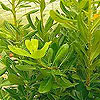
Holder of the Royal Horticultural Society's prestigious Award of Garden Merit, this tender evergreen shrub is grown for its sweetly scented, creamy white flowers which appear from late spring to early summer. Plants are found growing wild in China, Korea and Japan. In the UK, they are best grown either in the greenhouse border or in a large container of John Innes No3 soil-based compost. Water regularly and feed once a month when in growth but keep on the dry side during winter.
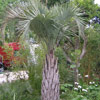
Butia yatay Jelly Palm
An interesting and unusual addition to the exotic garden. With its dramatic, arching foliage and wonderful prehistoric-looking trunks, the only thing that lets this palm down is its marginal hardiness. Arguably only reliably withstanding temperatures down to -5C (23F) , this rare Argentinian species is still worth a try in the milder areas of the country . Differing from its more well-known cousin Butia capitata by retaining its leaf stems on its trunk, it also requires a more quickly draining soil to mimic the mediterranean conditions of its natural habitat. To maximise chances of success, choose the biggest size you can afford and plant in a warm, sheltered site, preferably near a south facing wall.
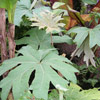
Tetrapanax papyriferus Rice Paper Plant
The huge hand-shaped foliage of this vigorous shrub make it a must for any serious fan of tropical-effect gardening. Its deeply-lobed leaves have curiously powdery undersides complemented by strange woolly flowers, adding to the plants jungle-like appearance. Despite being evergreen in its moist woodland home of Southern China and Taiwan, this species is usually treated as a half-hardy herbaceous perennial in the UK. Here if given a thick mulch & sheltered spot, plants cut back to ground level by winter frosts will invariably reappear promptly the following spring. For best results, plants should be given a moist, shady and sheltered spot, to mimic the conditions of their forest home. The inner pith of the stems is the source of "rice paper", which is used in China to wrap sweets, make handicrafts and even prepare surgical dressings.
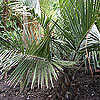
Jubaea chilensis Chilean Wine Palm
The hardiest of all feather-leaved palms. This slow growing species is characterised by its elegant, smooth grey trunks and long architectural leaves. With fully mature specimens reputedly hardy down to -10C (14F), this palm is well worth a try in more sheltered areas. Native to the warm temperate forests of coastal Chile, these palms require a well-drained sunny position to reflect the Mediterranean conditions of their natural habitat. Various indigenous groups in Chile have long harvested this plant for its sweet, sticky sap, which can be made into a powerfully intoxicating wine (hence its name).
Zantedeschia aethiopica Arum lily
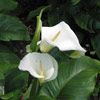
This is a wonderful architectural plant for pond margins in areas that do not suffer from very hard frosts. The leaves alone are an attraction. They are large, 40cm (16in) long, and arrow-shaped, and a bright, glossy green with distinct veins. However, arum lilies are mainly popular for their serene, white flowers. These are in fact spathes, wrapped round a thin, creamy yellow column, or spadice. They make superb, classy cut flowers. Grow the arum lily as a water plant, planting it into a special aquatic basket, in water up to 30cm (12in) deep. Or you can plant it into moist soil around the pond, protecting it with a deep mulch over winter. The Royal Horticultural Society have given it their prestigious Award of Garden Merit.
To view the panoramic image, click on the garden with your mouse and drag it around the picture. To find out about the planting hotspots in the garden, click on the leaf icon. To watch a video about the architectural features in the garden, click on the arrow icon.
If you're having problems viewing the panoramic images, take a look at our still photography of all of the show gardens.
"The essence or spirit of the design is to provide a window into the world of zoo horticulture, through a small adaptation of the planned Gorilla Kingdom landscape at London Zoo, which will showcase the very best in modern captive animal welfare and enrichment through realising the potential for plants in zoos."
Graham Pockett - designer of The Gorilla's Jungle Garden
Vote now for your favourite garden in the BBC RHS People's Award.









 "The essence or spirit of the design is to provide a window into the world of zoo horticulture, through a small adaptation of the planned Gorilla Kingdom landscape at London Zoo, which will showcase the very best in modern captive animal welfare and enrichment through realising the potential for plants in zoos."


