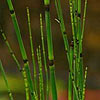
A fast-growing horsetail that has unbranched stems with rough black ribs which slightly constrict the stem. As a marginal plant in a garden setting needs confining to prevent unwanted spreading. Plant in an aquatic basket lined with Hessian to restrict growth. As the stems remain green throughout the winter provides useful winter interest, and its slightly pre-historic look makes it a curiosity for the pond.
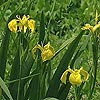
Iris pseudacorus Yellow Flag
Few garden ponds are large enough to contain this vigorous water iris. Large clumps of green leaves produce elegant, yellow flowers. Ideal for wildlife gardens, it can become invasive. It looks particularly good if planted in naturalised drifts among other moisture-loving plants. It also associates well with dark blue flowered plants. If you don't have room for a pond or bog garden, try growing it in a large container filled with water.
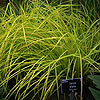
Carex elata 'Aurea' Bowles' golden sedge
A delightful dwarf sedge forming compact tufts of arching, dark green leaves, each edged with white, which give the plants a considerable sparkle. Plants look good grown towards the front of a moist border or among other plants, especially compact perennials and grasses, since they tolerate light shade. However they also look good grown at the edge of a pond, and are a useful solution to the problem of what to plant as a marginal that looks authentic but will grow in normal border soil instead of needing wet bog garden conditions. The Royal Horticultural Society has given it its prestigious Award of Garden Merit (AGM).
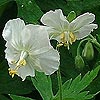
Geranium phaeum 'Album' Hardy geranium
One of Matthew Biggs' favourite plants for shady spots, Geranium phaeum 'Album' thrives in damp soil. From late spring to early summer, it produces clear white flowers with reflexed petals and golden anthers. Trouble-free to grow, plants can be propagated by digging them up and dividing them in spring. They make excellent ground cover.
Cornus alba 'Aurea' Red-barked dogwood
A Siberian and Korean shrub, this is very vigorous and eventually makes a large plant if not pruned regularly. Hard pruning helps to rejuvenate plants and replace old, dull stems with brightly coloured young growth. The species has fine, red stems in autumn and winter, but is too vigorous for many gardens. Garden varieties are more restrained, and 'Aurea' is one of the best, combining winter colour with the soft greenish-yellow of its foliage in summer. To get the benefit of both, cut down one third of stems each spring. The Royal Horticultural Society has given it the Award of Garden Merit (AGM).
To view the panoramic image, click on the garden with your mouse and drag it around the picture. To find out about the planting hotspots in the garden, click on the leaf icon. To watch a video about the architectural features in the garden, click on the arrow icon.
If you're having problems viewing the panoramic images, take a look at our still photography of all of the show gardens.
"The garden is contemporary and organic and investigates the textures of hard landscape materials and planting. It's inspired by the natural world as well as the work of architects Antonio Gaudi and César Manrique.
"It includes water as a key element and uses it in a substainable manner; recognising the value of the resource. The garden is spiritual and sensory in character."
Sarah Eberle - designer of Walking Barefoot with Bradstone
Vote now for your favourite garden in the BBC RHS People's Award.









 "The garden is contemporary and organic and investigates the textures of hard landscape materials and planting. It's inspired by the natural world as well as the work of architects Antonio Gaudi and César Manrique.


