

 | ||
| Focus on Africa Magazine home | |
| Last updated: 22 December, 2009 - Published 09:59 GMT |
|
| | |
 Email a friend Email a friend |  Printable version Printable version |
| | |
 | | |
| ||
 |
| Audrey Brown's memories of the day Nelson Mandela was released are still vivid |
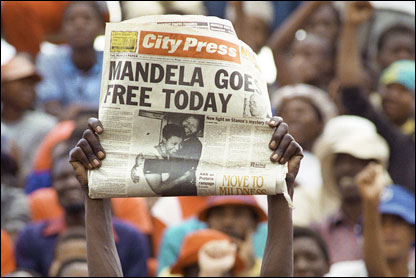
Just a week earlier South Africa's last white president, FW de Klerk, had announced to the world that Nelson Rolihlahla Mandela would walk free from jail.
At the time, I was a cub reporter for the crusading anti-apartheid newspaper Vrye Weekblad. And I was breaking up with my long-term boyfriend and consolidating a relationship with someone else.
But my love-life took a back seat as one of the most exciting events in my personal and professional life began to unfold.
It may sound lofty now - but this political event was personal.
Everything my family and comrades had held to be true - that we would defeat apartheid, that all the authentic leaders of the people of South Africa would be freed and that our true aspirations would finally be realised - was about to come true.
|  We marched through the streets of Johannesburg, taunting the police with our victory chants. They chased us and beat us up. We marched through the streets of Johannesburg, taunting the police with our victory chants. They chased us and beat us up.  |
I laughed with delirious joy because everything was suddenly possible, just like we knew it was when - as singing children - we threw stones at the staggering giant that was apartheid.
I cried because so many of my friends and family had died trying to make this happen, waiting for it to happen.
I so wished that my maternal grandfather was alive to witness the day.
My paternal grandfather had gone into exile in the 1950s and this meant we would finally meet him - and the aunt, uncles and cousins we did not know.
My father and his siblings would see their father again after 31 years.
My grandmother would be reunited with the man who had left her with their four children to go into exile.
I would find out what had happened to my friends who had disappeared across the borders, to go and fight to bring this day closer.
My family - and my country - would be whole again.
We marched through the streets of Johannesburg, taunting the police with our victory chants. They chased us and beat us up.
The old beast tried hard to put the joyous genie of victory back into the bottle of repression.
One of my colleagues - a white Afrikaner - ended up with a bloodied face, dazed from a policeman's club - on the cover of the magazine Index on Censorship.
But nothing felt like pain and nothing felt like work that week as we started putting together a special edition of our newspaper.
And then it was Sunday.
| 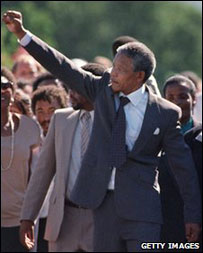 |
| Mandela raises his fist as he walks free from prison in 1991 |
With a new boyfriend and old friends - and a towering joy - I sat in front of the television, waiting to see the man whose release was key to ending the political crisis in South Africa.
I know it sounds a bit silly but it did feel a bit like waiting to see the bride's dress at an important wedding; or waiting to see a beloved and long-awaited newborn baby for the first time.
We did not know what he would look like or what he would be like.
In a way we did not care, because the very fact of his release represented the sum total of our achievement. Apartheid was finally defeated.
It had stumbled under the words of disgust and condemnation from the whole world, and the sacrifice of millions inside and outside South Africa.
Mr Mandela's release was proof that it had finally fallen. We had won.
Nothing could be better than this. I was thinking all those things as I waited to see him.
The world had stopped to watch with us and everyone was subjected to the same stolid commentary from the South African Broadcasting Corporation's anchorman.
Then the moustached presenter - so typical of the old South Africa - said: "There he is now…" or words to that effect; and a tall, upright man in a suit walked slowly out into the sunshine, holding his beautiful wife's hand and raising the other in a black power salute.
That is when the very centre of my soul suddenly flamed and melted into a burnished joy that has flared and faded over time as South Africa went through, and continues to suffer, a painful rebirth.
As I think of that day now, I feel that molten-core flame again and I know that - whatever happens to my country and my continent - it will never really be extinguished.
Audrey Brown is a presenter at the BBC World Service
This article appears in the January - March 2010 edition of BBC Focus on Africa Magazine.
 SUBSCRIBE: With the sharpest writing and the finest photography, a Focus on Africa magazine subscription will keep you abreast of all the important developments across the continent.
 | | |
 | | Focus on Africa The magazine for Africa from the BBC World Service |
| ||
| | |
 | | Subscribe to the magazine Click here for current rates and details of how to subscribe |
| ||
| | |
 | | BBC World Service Africa your gateway to the best news audio and multimedia content |
| ||
| | |
| Email a friend | Printable version |
 | |
| SERVICES |
