
A hybrid embryo is a mixture of both human and animal tissue.
Human-animal hybrid embryos
The science
Bioethics: Human-animal hybrid embryos
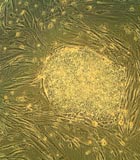 Human stem cells ©
In May 2008 a cross-party attempt to ban hybrid human animal embryos was defeated on a free vote in the House of Commons, by 336 to 176. MPs had been debating the Human Fertilisation and Embryology Bill, which would allow regulated research using hybrid or 'admix' embryos, where the nuclei of human cells are inserted into animal eggs. The resulting embryos would be kept for up to 14 days to harvest stem cells.
In the present state of science, hybrid embryos are produced as research tools, and only kept alive for 14 days or fewer. The article below only deals with the ethical issues of this case, and not with the ethics of producing new creatures that are a combination of animal and human.
A hybrid embryo is a mixture of both human and animal tissue. There are several types of hybrid embryo (listed below), but recent controversy has focused on cytoplasmic embryos.
These are created by transferring nuclei containing DNA from human cells into animal eggs that have had almost all of their genetic information removed.
The resulting embryos are more than 99% human, with a small animal component, making up around 0.1% (more detail below).
The embryos are grown in the lab for a few days, then harvested for stem cells: immature cells that can become many types of tissue. The embryonic stem cells are used in research into different diseases as a way of addressing the shortage of human eggs available for research.
Scientists do not intend to actually create living animal-human hybrids. [Such beings are often referred to as chimeras after a creature in Greek mythology which had a lion's head, a goat's body, and a serpent's tail.]
Some 200 medical charities have urged MPs to support legislation allowing the creation of animal-human embryos.
Possible types of animal/human hybrid embryos
- Cytoplasmic hybrid embryos: embryos created through cell nuclear replacement using animal eggs
- Hybrid embryos: embryos created by mixing human sperm and animal eggs or human eggs and animal sperm
- Human chimera embryos: human embryos which have animal cells added to them during early development
- Animal chimera embryos: animal embryos which have human cells added to them during early development
- Transgenic human embryos: human embryos which have animal genes inserted into them during early development
Source: Human Fertilisation and Embryology Authority
Proportions of human and animal DNA
In cytoplasmic hybrid embryos, all the DNA in the cell nucleus is human. The remaining animal DNA is found only in the mitochondria, which are small rod-shaped organelles found outside the nucleus that produce energy for the cell. Mitochondrial DNA is separate from nuclear DNA; it is not involved in cellular division or reproduction.
So the main genetic material is 100% human. Embryos produced by this technique are considered fully human - a "live human embryo" - by the Human Fertilisation and Embryology Act.
A combination of human nuclear DNA and animal mitochondria is likely to make a difference to the resulting cells, but not enough is known about mitochondrial disorders to predict what the effects might be. The House of Commons Select Committee report acknowledged this and viewed it as a positive point.
However, rather than deem this a reason not to conduct such research, [Dr Justin St John from Birmingham University] believes that the creation of human-animal chimera or hybrid embryos may actually "offer us the opportunity to elucidate some of the causes of mitochondrial DNA disease" and that "not to allow this work to go ahead would considerably disadvantage experimental work in these fields".
House of Commons Select Committee on Science and Technology Fifth Report, June 2007
Public opinion
In 2007, a poll conducted by the HFEA found that 61% of the public supported the research after having the process and goals explained to them, while a quarter was opposed to the research.
The debate
Ethical issues
We believe, too, that we are God's partners in the work of creation, both as innovators and as protectors, and that this partnership obliges us to be guided by ethical principles.
Office of the Chief Rabbi, Memorandum to Select Committee on Science and Technology November 2004
There are strong arguments on both sides of the ethics of creating human/animal embryos. We've listed some of the arguments put forward below.
In some cases the arguments seem to be similar but expressed in a different way.
In some cases arguments on the same side of the case seem to conflict with each other.
Quotations on both sides of the argument can be found at BBC News - In quotes: The ethics of embryos
Arguments against creating human/animal embryos
...the creation of an animal-human being represents a natural border that has been violated, the most grave of violations.
Bishop Elio Sgreccia, president of Pontifical Academy for Life, May 2007
- It blurs the distinction between human beings and other animals
- It's a repulsive thing to do
- It's unnatural
- It's playing God
- It violates human dignity
- Human embryos have a special (moral) status from the moment of fertilisation that should be respected and this makes any research using human embryos wrong and a violation of their human rights
- It's wrong to create beings (embryos) that are solely at the disposal of scientists; it says that it is acceptable to create motherless beings and could open the way to the creation of beings that are effectively owned by whoever controls the medium in which the embryo develops
- Even if using human embryos for research is sometimes acceptable, creating animal/human hybrid embryos is a step too far
- It's the start of a slippery slope that could lead to creating hybrid human/animal creatures capable of independent life
- It's wrong to use animals in this sort of research
- The research will be of little scientific value - no new treatments have been produced by embryonic stem cell research
- Mixing human and animal genetic material risks creating new diseases
Arguments in favour of creating human/animal embryos
We think there is nothing illegal, immoral or unethical about this.
While we understand the concerns, we think they are largely founded on misinformation. People think we are generating some sort of hybrid animal. This is just cells, just for science. No animal is ever going to be created.
Professor Chris Shaw, Kings College London, 2008
- It may produce enormous benefits for human beings
- It is a strictly limited procedure - creatures capable of independent life will not be created. These are 'just cells', not actual beings
- It avoids the use of human eggs in research
- The genetic contribution of the animal to the embryo is so small that it is essentially a human embryo
- Since the embryo was not produced by human fertilisation, it can't be regarded as a human embryo
- It's very similar to cell nuclear replacement research, and if we accept research on human embryos up to 14 days, there is no reason to oppose research on an embryo that is less than wholly human
- Neither human nor animal rights are violated since the embryo will never be allowed to become a human or an animal
BBC iD
BBC iDBBC navigation
BBC links

BBC © 2014The BBC is not responsible for the content of external sites. Read more.
This page is best viewed in an up-to-date web browser with style sheets (CSS) enabled. While you will be able to view the content of this page in your current browser, you will not be able to get the full visual experience. Please consider upgrading your browser software or enabling style sheets (CSS) if you are able to do so.

