
This article contains descriptions of the various methods used to carry out abortion.
Methods of abortion
Non-surgical abortion methods
The abortion pill
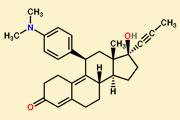 Chemical formula of mifepristone ©
This is a method of terminating early pregnancy using medications taken by mouth or by injection which produce a miscarriage. It was developed in France in the 1980s. It was launched in the UK in 1991 and the USA in 2000.
Medical abortion works in two stages: First the women is given the drug mifepristone, which blocks a hormone needed to make fertilised eggs stick to the womb lining.
After 48 hours, the woman is given a different drug, which triggers contractions and bleeding and causes the foetus to be expelled from her body.
Medical abortion can be used in the first 7 weeks of a pregnancy, while surgical abortion is usually delayed until 6 weeks or later. The earlier an abortion is performed, the safer it is for the woman.
Some women say they would prefer this method because it somehow "seems more natural", and because it avoids surgery.
Supporters of abortion rights point out that medical abortion, because it needs much less training than surgical abortion, has the potential to make abortion more easily available to women who want to terminate a pregnancy.
Pro-life supporters say that Mifepristone may pose health risks to women, although studies have not supported this.
The morning-after pill
The morning-after pill consists of a high dose of female hormones - the same hormones found in the normal contraceptive pill.
It needs to be taken within 72 hours of sex, and the earlier it is taken the more effective it is.
Morning-after pills can operate as a contraceptive or by producing an abortion, but it's almost impossible to know in which way they are going to work.
It operates as a contraceptive by preventing or delaying ovulation.
The possibility that it may produce an abortion arises from the morning-after pill's second method of operation.
In this method it acts on the lining of the womb so as to prevent a fertilised egg from implanting (sticking to the lining of the womb). Since the fertilised egg can't stick, it is expelled from the womb.
Many pro-life groups object to the morning-after pill as a form of abortion because it can operate after the egg has been fertilised. Those who disagree with this argue that the pregnancy does not begin with fertilisation, but with implantation, and say that if implantation is prevented there was never any pregnancy to abort.
The other moral objection to the morning-after pill is that it allows people to avoid some of the consequences of casual sex, and so encourages immoral sexual behaviour.
Intra-uterine device
There is also a mechanical morning-after method in which an intra-uterine device (IUD) is fitted up to 5 days after unprotected sex.
Surgical abortion methods
Vacuum aspiration abortion
In a vacuum aspiration abortion a tube is gently inserted into the womb through the cervix. The contents of the womb are sucked out through this tube.
Dilatation and evacuation, dilatation and curettage
In this method the woman's cervical canal is enlarged with tools called dilators. When the canal is sufficiently enlarged the womb is emptied by suction, or by having its contents scraped out with a tool called a curette.
Partial birth abortion
This is also called 'intact dilation and extraction'.
The procedure involves the extraction of the body of the foetus into the vagina before the contents of the skull are sucked out, killing the unborn, after which the intact foetus is removed from the woman's body.
Many women who opt for "partial-birth" abortions do so because their foetuses have severe or fatal anomalies or because the pregnancy endangers their lives or health.
Opponents of this method of abortion argue that the procedure is really a form of infanticide.
Around the BBC
BBC iD
BBC iDBBC navigation
BBC links

BBC © 2014The BBC is not responsible for the content of external sites. Read more.
This page is best viewed in an up-to-date web browser with style sheets (CSS) enabled. While you will be able to view the content of this page in your current browser, you will not be able to get the full visual experience. Please consider upgrading your browser software or enabling style sheets (CSS) if you are able to do so.

