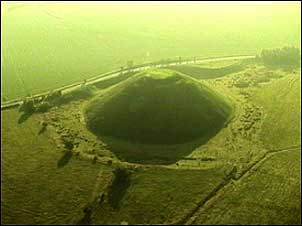
Silbury Hill is the largest man-made mound or tumulus in Europe. This huge mound is comparable in height and volume to the Egyptian pyramids with whom it shares the same time date. The hill comprises mainly chalk excavated from the surrounding area, and the mound stands 130 feet high.
It is thought that Silbury Hill was probably completed by about 2350 BC but why and how it was built remain a mystery. The hill forms part of the Avebury World Heritage Site. It has been estimated that it took 18 million man hours to build Silbury Hill, and that there are about 1/4 million cubic metres of earth and chalk inside it. There have been many theories as to the purpose of the huge mound. Some believe that Silbury was a giant sundial to determine time of year, whilst others have out forward views that it is the site of seasonal rituals or worship. Another theory is that the hill was built as a burial mound for King Sil and his golden horse.
Despite much investigation, the purpose and significance of Silbury Hill remains elusive. Its proximity to Stonehenge and Avebury stone circles suggest it may have had a religious, ceremonial or spiritual purpose. |