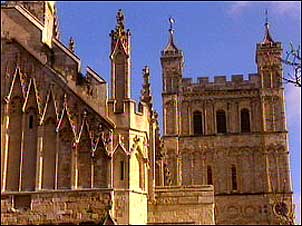
Exeter Cathedral has dominated the skyline of Devon's county town for over 900 years. The Cathedral of St Peter, to give it its full name, is located on the site of a Roman army camp and its origins date back to 1050 when the Bishop of Crediton and St Germans moved to Exeter. Today's cathedral owes its Gothic style to Bishop Bronscon who started rebuilding work around 1290. He started at the east end of the cathedral - work was almost complete when Bishop Grandisson, five Bishops later, took over. The cathedral is the only example in Europe of a decorated Gothic building almost in its entirety apart from the two northern towers. It also boasts the longest, unbroken stretch of Gothic stone vaulting in the world. Amongst the cathedral's many treasures are the Bishop's Throne, one of the finest examples of woodwork from the 14th Century, an antique clock made in 1376, and the East Window featuring original glass. In 1870 Gilbert Scott restored the quire and added the Martyrs' pulpit to the nave of the cathedral. One of the most infamous incidents in the cathedral's history was the murder of Precentor Lechlade in 1283. This was the result of a bitter feud between the then bishop, Peter Quinil, and the dean, John Pycot. |