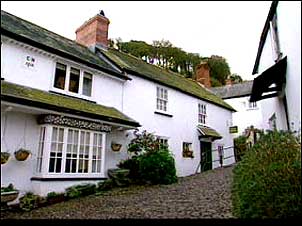
The secluded, picture-postcard fishing village of Clovelly clings to the steep cliff sides on the north Devon coast. Its main street, known as Up-Along or Down-Along, tumbles its way down a 440 feet cliff to the tiny harbour and ancient stone breakwater below. Its steep descent takes visitors past pretty cottages broken up by winding passageways and tiny lanes. It's almost as if Clovelly were stuck in time. The Clovelly Estate was acquired by the Hamlyn family in 1738. Clovelly's preservation owes much to Christine Hamlyn who dedicated herself to renovating the ancient cottages. Today the Clovelly Estate Company owns all of the buildings in the village and much of the land around it. It is responsible for maintaining the village and preserving its character. Crazy Kate's cottage is one of the oldest cottages in the village. About 250 years ago it was the home of Kate, the wife of a fisherman who used to fish out of Clovelly. Legend has it that she used to watch the fishermen from her window upstairs. One day she saw her husband fall over the side of his boat and drown. The story tells that Kate went mad after that and it's said that she was buried in her wedding dress. The herring fishing industry was once the staple industry of Clovelly, dating back to Elizabethan times. During the 1830's the fishing industry started to decline, but by the mid 19th Century another industry was starting to emerge - tourism. The village was popularised Charles Kingsley, author of The Water Babies and Westward Ho! The old traditions still have a place in Clovelly, and fishing is still an important part of life here with a new generation of fishermen. Also look out for Clovelly Dykes on the plateau above the village - this ancient earthworks dates back to the Romans and some experts believe it has its roots in the Stone Age. |