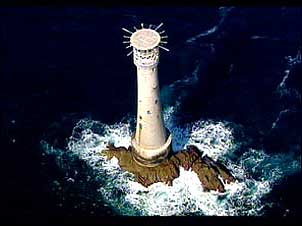
Bishop Rock is one of South West England's most dramatic and most remote locations imaginable. It is a testament to the power of nature and a defining symbol of Britain as an island nation. Standing on a rock ledge four miles west of the Scillies, Bishop Rock Lighthouse faces the full force of the Atlantic's waves daily. Bishop Rock was one of the most hazardous and difficult sites for the building of a lighthouse when work first begun on its construction.
The lighthouse has protected sea-farers since 1858 when it is built on a sheer rock rising 45 metres from the sea bed. There are about 5,700 tonnes of granite without any steelwork, glass engines and helipad at the moment. They're all dove-tailed with lead filling, and bolted into the actual granite rock which is underneath. Bishop Rock's light shines out for 24 nautical miles. In the old days the lighthouse had to rely on paraffin vapour lamps and, before that, candles. Today there are generators, batteries and a helipad which was built in 1976 - this means visitors can actually land on top of the lighthouse instead of coming in by boat. Bishop Rock was converted to automatic operation in 1991 and the last keepers left the lighthouse in December 1992.
Today the lighthouse has ten floors, and up to four visitors can stay here for a week to three weeks The control room is on the third floor - the lighthouse keepers can work on the station, manually, or remotely from their headquarters in Harwich, Essex. Bishop Rock is a wonder indeed, especially in glorious weather, but to withstand autumn gales and winter storms for months on end, perhaps that's where the true wonder of this place lies.
|