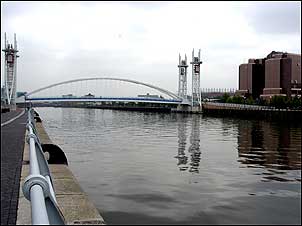
The Manchester Ship Canal is a great example of how engineering helped the North West to become an industrial powerhouse. Construction started in November 1887 and took seven years to complete, with Queen Victoria opening the canal in 1894. The canal runs for 36 miles from Eastham on the Mersey estuary to Salford in Greater Manchester. The Manchester Ship Canal is best described as a 'linear port', providing access for shipping to docks along its length. The Canal is also known as the 'Big Ditch', because of the immense size of the building project. It was dug virtually by hand by teams of 'navvies' - workers on the navigation or canal. Many workers died in the brutal working conditions. The canal uses much of the route of the Mersey and Irwell Navigation. The Barton Swing Aqueduct was constructed to replace Brindley's earlier, pioneering stone aqueduct across the Irwell. As well as the aqueduct, the Ship Canal has seven swing road bridges, five high level railway viaducts, and four high level road bridges. It also boasts five sets of huge locks - Irlam, Eastham, Latchford, Barton and Mode Wheel. The engineering brilliance of the canal enabled ocean-going vessels to navigate their way from the Irish Sea into the industrial heart of Manchester. The Canal is still a working waterway, although the number of ships making their way from the mouth of the Mersey to Salford Quays has declined. |