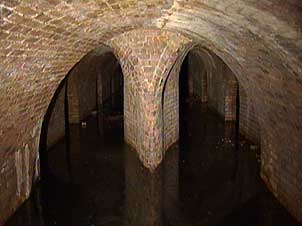
London's Sewers are a triumph of Victorian engineering. Until the new sewer system was built, raw sewerage went directly into the Thames which was also used for drinking water. As a result cholera was rife, and one of the worst epidemics killed over 10,000 Londoners in 1853. Drastic action was needed following the 'Great Stink' of 1858 when the smell was so bad that the problem reached crisis point. The government called in top engineer, Joseph Bazalgette, to create an underground complex of sewers. He and his team built 82 miles of intercepting sewers parallel to the River Thames, and 1,100 miles of street sewers at a cost of £4.2 million. Work started on this ambitious enterprise in 1859 and was virtually complete by 1868, a major achievement for its time. Bazalgette drove himself to the limits in realising his subterranean dream. The job was made harder by having to work alongside the developing underground railway system and emerging above ground railway systems. Bazalgette used 318 million bricks to create the underground system and dug up more than 2.5 million cubic metres of earth. Originally built to serve two and a half million people, the sewers were already serving four million by their completion. To avoid tunnelling under the West End, Bazalgette reclaimed land by the Thames to create the Victoria Embankment. Today the extended system serves a population of eight million and is essential to the smooth-running of London. |