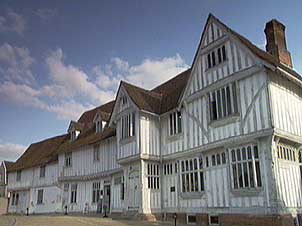
Lavenham is said to be the best example of a medieval wool town in England. The town is characterised by its hotch-potch mixture of half-timbered buildings huddled together, some leaning at strange angles. It boasts 361 listed buildings including the impressive Guildhall which stands in the centre of the town. This gem of a village was built on the riches of the medieval cloth and wool trade. The stunning timber-framed Guildhall housed the Wool Guild of Corpus Christi which was established in 1529. The town was most famous for its blue broadcloth exports during the reign of King Edward III. Great wealth was generated by the wool trade, and in 1524 Lavenham was the 14th richest town in the country, paying more tax than big cities such as York and Lincoln. The evidence of this wealth can still be seen today. Rich merchants rebuilt their houses with studded timbers to demonstrate their wealth. Even the parish church of St Peter and St Paul, sited on a hill top at the end of the main high street, is lavishly decorated. When competition from European merchants brought cheaper cloth, Lavenham's status as a wool town declined. By the turn of the 20th Century many properties were virtually derelict but restoration efforts have helped to renovate many of the town's historic buildings. Restoration of The Guildhall, in particular, has breathed new life into the centre of the village and stimulated tourism. Another point of interest is the Old Grammar School where the artist John Constable attended as a boy. |