 | 24 September 2014 |

| |
| BBC Homepage | | |
| |||
| Contact Us | | |
Nature FeaturesYou are in: Dorset > Nature > Nature Features > Bag that bird! 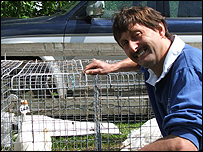 Bag that bird!Keeping poultry is Britain's fastest growing hobby but could you tell chick from a clucker? BBC Dorset spoke to so-called Chicken Supremo Jim Butt at Buckland Newton's Goose Auction for some top-tips on bagging a beautiful bird. Jim Butt has been working with chickens since he was a little boy and has been running a small hobby/business for more than 15 years. He has also bred ducks, geese, peafowl and turkeys - and has even sold poultry to Sir Paul McCartney. Here's his guide on what to look for if you're buying poultry at auction. 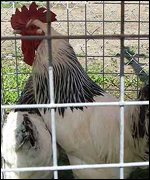 Feather condition is important Poultry popularity"More and more people are keeping poultry. Auctions all over the south are always packed with budding bidders. People are aware that a lot of the eggs they buy come from deep litter and battery caged birds. It's nice to have a few happy chickens running around the garden giving you some eggs! They're also great for children as they can learn about life." Choosing your chicken"There are lots of things to look out for in a bird if you're buying from an auction. For one, you can't hold them because they are shut in pens." Bright eyes"You need to look out for nice bright eyes. There should be no bubbles on the eye or crustiness. Also, always pick a bird with a clean nose. You don't want to see a chicken with a runny nose!" Bottom line"Sorry to be rude here, but to check if a chicken is healthy you need to look at its bottom! Make sure there is no faeces stuck around its bottom. You also need to look on the floor of the pen to make sure there's no diarrhoea. If there is diarrhoea it means that the chicken is very loose." Fine feathered friend"Take a look at the general feather condition of the chicken. You also need to check out the chicken's comb. If the chicken has a nice young small scarlet comb it usually indicates that it's a pullet - which means it's at the start of its laying career." 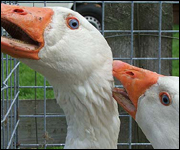 Determine goose gender by neck damage A leggy bird"Look at the bird's legs. If you see great big thick legs it means it's an old bird. If it's got nice slim slender legs then it's usually a young bird. Looking at young legs has got me into trouble in the past!" Gendering geese"When choosing a goose, again, as with chickens, make sure the bird has clean plumage and clean eyes. If you're trying to work out the sex of a goose, which is quite hard for the inexperienced, my tip is to look at the back of the bird's neck. If you see some feathers missing you can tell that ganders have been treading it [trying to mate]. During treading the male bird catches hold of the female bird around the scruff of the neck so damage to the feathers in this area means it’s a lady bird." Mistakes to avoid - don't chase a 'bargain'"The biggest mistake people make when going to a poultry auction is chasing a bargain. Often what people think is the deal of the century ends up being an awful buy when they get the bird home because people often offload their older poultry at auctions". Cock birds"Another mistake happens when buying a hen and chicks as one lot. Often most, if not all, of the chicks, end up being cock birds. I often get people ringing me up saying 'Jim, I bought a hen and chicks at an auction and all the chicks are cock birds - can you believe it!' and I say 'yes I can believe it, because that's what happens at auctions!'" Get advice"If you're not experienced and you go to an auction you really need to talk to somebody who knows a little bit about what they're on about! Also, do some research! I walk around all the pens before the auctioneer gets to them, making a note of how much I think the birds are worth and if it's in good health. If it's not what I want I just pass it by." last updated: 28/05/2008 at 09:29 Have Your SayDo you keep chicken and geese at home? Share your tips for successful poultry keeping and happy birds. Jason mitchell KERRY Vic Marshy Dan matty scott You are in: Dorset > Nature > Nature Features > Bag that bird!   
| ||||||||||||||||||||
| | About the BBC | Help | Terms of Use | Privacy & Cookies Policy |

