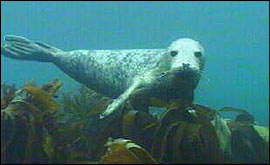
|  | A Devon marine conservationist is warning there is no room for complacency despite a report which suggests our coastal waters are in better health than anywhere else in the UK.
The survey, headed by the Department of Environment, Food and Rural Affairs (Defra) found that the South West has a greater variety of fish species than any other region.
The study also found that around the UK, climate change, pollution and fishing are each having a major impact on our seas.
However, in the South West, the sea - on the face of it at least - seems to be relatively healthy.
Here, the rise in sea temperature is not so high as elsewhere - up by between 0.12 to 0.29 degrees centigrade.
But there is a change in sea conditions, with the intensity of storms increasing and average wave heights also on the up.
 | | Kelvin Boot |
Despite the largely encouraging picture, the director of Plymouth's National Marine Aquarium, Kelvin Boot, is urging caution.
He says there is no room for complacency and that the appearance of non-native species isn't necessarily a good thing.
"For most of us the sea is this great big grey thing that's always there and where we can chuck all our rubbish into and we don't have to worry about it.
"But chickens are coming home to roost. The sea does appear to be changing. Just because we have a greater variety of fish doesn't mean we are not having an impact on the sea.
"Here, we are very fortunate in many respects because of our geographical location between the cold nothern zone and the warmer south zone.
"So we have a diverse mix of life in our seas. We have warm water species moving in and whether that indicates climate change or not is a point for debate.
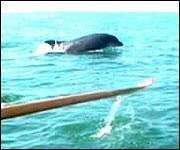 | | A dolphin in Plymouth Sound |
"We are getting barracuda fish and other species people usually associate with more exotic places. Divers have seen trigger fish, and we're seeing the mighty sun fish many months of the year.
"A lot of people don't realise that we can see the largest turtle species in the world - the mighty leatherback - off Plymouth, the South Hams and Torbay.
"Some of the new species are staying and becoming resident and breeding.
"Fish twitchers are coming down to see the unusual species, which is good because the more eyes we have the more information we get."
But this isn't always a good thing: "We need to be cautious," said Kelvin. "It's nice to see so many unusual fish but you do think 'what's it doing here. Something's gone wrong."
"I feel we are undergoing climate change and it's at an accelerating rate. It means some cold water species are moving north. We're getting some new species but others are moving on and we need to ask: 'Is this a fair exchange?' In balance, the answer is probably not.
"Climate change is a major concern, and so is over-fishing. We all know about the shortage of cod and skate is almost extinct around the South West.
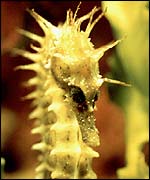 | | A spiny seahorse |
"We thought the fish stock was a bottomless pit of wealth but we're scraping the bottom now. We're messing with things we don't understand.
"We've also seen large numbers of dolphins being killed.
"Oil pollution is always a threat in our area, right next to the shipping channels. We need to look at how oil is moved.
"And recreation is also an issue. Around our shores and especially our estuaries, we have seahorses but they live in a very fragile environment."
The aquarium hopes to play a big role in the Government's "Changing Attitudes to Climate Change" campaign.
And Kelvin welcomes the Government's announcement that it will be working with interested parties in a concerted attempt to monitor and protect our coastal waters.
The proposed UK Marine Monitoring Strategy will provide updated information on how our seas are changing and why.
"It is encouraging that the Government is taking an interest in the sea," said Kelvin.
Article published: 3rd February 2005
|