| Birds are flocking back | |
|  | | Cirl buntings are making a comeback in Devon. |
| | There are signs of a revival in the population of wild birds living in Devon's countryside.
A new census carried out by the government shows the long term decline in farmland birds seems to have been halted. |
| | | Several bird species threatened with extinction 10 years ago are recovering strongly thanks to successful conservation measures.
In the South West, the 40 year decline in the population of farmland birds appears to have flattened out.
Figures published by the government show that the farmland bird population remains at less than 60 per cent of it 1970 level.
Farmland bird populations declined by almost half between 1977 and 1993.
However the decline has slowed down in recent years and the 2003 farmland bird indicator is virtually unchanged from the 1993 figure.
Bitterns, stone curlews and corncrakes are among the success stories following efforts by conservationists and incentives to farmers to protect their habitats.
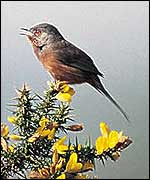 | The Dartford warbler has returned to East Devon.
Photo: RSPB |
An ongoing project in South Devon has seen a six-fold increase in the numbers of threatened cirl buntings.
And the Cetti's warbler, which can be found on the Exminster Marshes near Exeter, is also doing well.
The restoration of heathland in parts of East Devon has boosted the population of Dartford warblers. The species disappeared from the area in the late seventies.
While there are encouraging signs of recovery from some farmland species, this is not true for all.
The RSPB says concerns remain about species such as the corn bunting, grey partridge and skylark.
"These figures mask the ongoing decline in some farmland birds," said Peter Exley of the RSPB in the South West.
"Many farmland birds are still in pretty poor shape compared with what they were three decades ago. Largely due to the loss of nesting sites and food.
"But there are some very positive local signs. In particular the recovery of the cirl bunting where concerted efforts are showing how we can reverse declines."
Birds like skylark , cirn bunting and grey paetridge are all still trouble.
The government figures show the overall population of wild birds in the UK has risen by 7% over the last 10 years.
The UK's coastal bird population is thriving, having risen by almost 40% since 1970 and by around 20% since 1985 - the year of the last complete census.
Species faring particularly well are guillemot and gannet, with only herring gull and little tern showing a decline since 1970.
Bird populations are considered to be a good guide to the broad state of wildlife and the countryside because they occupy a wide range of habitats and tend to be near or at the top of the food chain.
Environment Minister Elliot Morley said: "These figures show some encouraging
signs, but there is no room for complacency and much more remains to be done.
"It is encouraging to see that scarce birds like the woodlark and Dartford warbler are on the increase, reflecting the huge amount of work that has been put in by conservation and funding organisations working in partnership on
heathland restoration.
"I am also pleased that populations of species such as the bittern, stone
curlew and cirl bunting are recovering."
Article first published: 22nd October 2004
| | | |
|
| | Weather |  | | Monthly statistics, features and information. |
| E-cards |  | | Send an e-postcard of glorious Devon to a friend. |
| In Pictures |  | | Browse through our vast selection of photo galleries. |

BBC Devon
Broadcasting House
Seymour Road
Plymouth
PL3 5BD
(+44) 01752 229201
devon.online@bbc.co.uk
|
|