| Downtrodden ants return home | |
| 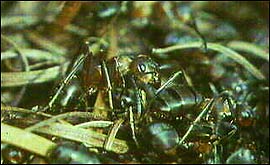 | | The ants have returned home to Bovey Heath. |
| | A rare species of ant has been returned to its home at Bovey Heathland in South Devon. The colony of narrow-headed wood ants was moved to Paignton Zoo several years ago because its natural habitat was being damaged. |
| | | The Devon Wildlife Trust stepped in to save the ant colony in 2002 by buying the internationally important site where they live.
Bovey Heath, which is home to more than 50 protected species, had suffered major damage as a result of bike scrambling and illegal dumping.
The ant, known by its latin name Formica Execta, can only be found in the Bovey Basin after being wiped out across the rest of England.
There are two colonies - at Chudleigh Knighton Heath and at nearby Bovey Heath. Chudleigh Knighton Heath is already a DWT nature reserve.
The colony at Bovey Heath had been under threat for years from illegal motorbiking and from cars being dumped and set alight.
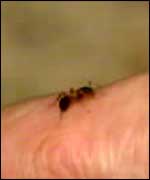 | | There are only two surviving colonies of Formica executa. |
In an attempt to save the ants and the internationally important heathland, the DWT bought the land, which is a site of special scientific interest.
As a first step the colony of narrow-headed wood ants was taken to Paignton Zoo while clearance work was carried out on the heath.
Since then the trust has cleared 30 tonnes of rubbish and 50 burned out cars and now the site is ready for the ants to return.
"Its return is quite a symbolic moment because it marks the success of our efforts to manage the site well," said Trust Wildlife Officer Stephen Carroll.
"In 1989 there were seven nests of this species of ant at Bovey Heathfield. By 1999 there was only one nest remaining."
"It's no longer a car graveyard and bike track and we've put a lot of work in to clear the site and prevent further erosion."
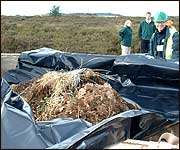 | | The ants being returned to their natural habitat. Photo: DWT. |
Mr Carroll said the transfer would begin by carefully digging up the nest from its site at the zoo.
"We'll be transferring the ants nest on wooden pallets," said Mr Carroll.
"It will then be lowered into a pre-dug hole and the pallet will be removed.
"There will be some more digging, but hopefully it should all go together like a jigsaw."
Bovey Heathfield is one of the most important lowland heath sites in the county, with the potential to offer the right conditions for a huge range of wildlife which requires the specific conditions of this type of habitat.
The DWT has secured financial support from English Nature to run the site as a Local Nature Reserve.
Devon Wildlife Trust's work to improve Bovey Heathfield has included transplanting heather turf to cover bike tracks and ruts and scarifying bare ground to encourage heather seeds to germinate.
As part of the project Stephen Carroll was employed as a community officer for the heath to ensure the site is respected in future.
"The next thing we want to do is encourage more people to visit Bovey Heathfield," said Mr Carroll.
"We want them to see that it’s not a dumping ground any more. It's a beautiful heathland which is home to protected species including Dartford warblers, stonechats, skylarks and bats, as well as the ants."
Page updated: 25th February 2004
| | | |
|
| | Weather |  | | Monthly statistics, features and information. |
| E-cards |  | | Send an e-postcard of glorious Devon to a friend. |
| In Pictures |  | | Browse through our vast selection of photo galleries. |

BBC Devon
Broadcasting House
Seymour Road
Plymouth
PL3 5BD
(+44) 01752 229201
devon.online@bbc.co.uk
|
|