ID parade of key seashore species | |
| 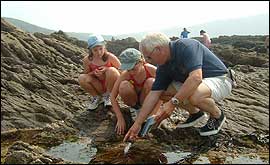 | | Keith Hiscock of MarLIN points out which species live in this rockpool at Wembury |
| | A glossy guide with colour photos of seashore species is being distributed all around the country by a Plymouth based conservation group. It's hoped people will use the pictures to identify what's around our beaches - and where.
|
| | | Here's your chance to help discover what species are thriving in and around our ever-changing seashores.
A seashore species survey is being run by the Plymouth-based Marine Life Information Network (MarLIN), which is keen to find out what can be found and where.
To help with the survey, they've produced a water-proof colour guide which is effectively an Identity Parade of 42 species.
So if you spot eelgrass, seaweeds, barnacles, limpets, seashells, crabs or anemones, you can take a quick look at the photographs to see which species it is.
Details can then be sent to MarLIN via internet, post or over the phone.
 | | Rockpools at Wembury |
This is an important piece of research - which has funding for the next two years from groups including English Nature and the Government's Environmental Action Fund.
The guide to seashore species was launched at Devon Wildlife Trust's Wembury Marine Centre as part of the trust's marine week.
The times they are a-changing
The reason the survey is so vital is that our seashores are undergoing big changes as a result of climate change.
Guy Baker, outreach officer with MarLIN, said asking the public for help is the best way of getting a true picture: "There is a limited number of marine scientists, so we're enlisting the public to help us.
"They'll be our eyes and ears all around the country, because we are distributing the leaflets nationally."
He added: "There's no doubt that things are changing and one of the reasons for that is climate change. We need to know exactly how things are changing.
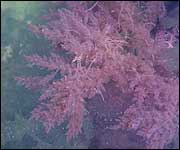 | | Harpoon weed |
"Rockpools are a very good place to observe changes. For example, at the moment, we have a lot of harpoon weed (a non-native species), and we only get a lot of that during hot summers."
The accidental introduction of non-native species has had an impact on our seashores.
Keith Hiscock, Programme Director, was on hand at Wembury to point out to a group of youngsters a rockpool full of wireweed.
This species was accidentally brought to South West shores by a boat from Japan.
Keith explained how this survey will help with our knowledge of seashore life for a long time to come: "In the next decade we want to get a real baseline of what we've got and where it is. And that knowledge can be used for the next 100 years.
"We'll verify the records that come to us from the public and send them to the National Biodiversity Network."
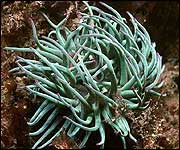 | | Snakelocks anemone is a sign of climate change |
And he said: "Climate change is especially interesting, and range extensions of some species that only occur in our southern coasts are already being seen as global warming occurs."
The seashore survey is being tied in with schools' national curriculum, and it's hoped young people will have a big role to play in spotting species for the research project.
And of course, it's not just what is found around our shores which tells us of the health of the environment - what ISN'T found is also an indicator.
You can find out how to take part in the survey by looking at our factfile on the left of this page.
Article first published on 12th August 2003
| | | |
|
| | Weather |  | | Monthly statistics, features and information. |
| E-cards |  | | Send an e-postcard of glorious Devon to a friend. |
| In Pictures |  | | Browse through our vast selection of photo galleries. |

BBC Devon
Broadcasting House
Seymour Road
Plymouth
PL3 5BD
(+44) 01752 229201
devon.online@bbc.co.uk
|
|