| Where dinosaurs once roamed... | |
| 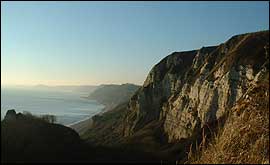 | | The heritage coast near Branscombe |
| | The East Devon and Dorset coast - dubbed The Jurassic Coast - is a designated World Heritage Site. The rocks along this stretch of the coastline date back to the days when dinosaurs ruled the world - 200 million years ago. |
| | | A natural wonder of the world:
The East Devon coastline has been placed right up there alongside the most amazing natural wonders of the world, such as the Grand Canyon, Great Barrier Reef and the Galapagos Islands.
The cliffs along East Devon and Dorset were granted World Heritage Status by the United Nations' cultural arm, Unesco, in December 2001.
Why? Because this 95 mile stretch of coast has rocks dating back 200 million years, and contains prehistoric fossils. In places, there are even dinosaur footprints.
Fossil hunting is actively discouraged at certain sites, and can also be dangerous because of rock falls. Where fossil hunting is allowed, there is a strict code of conduct.
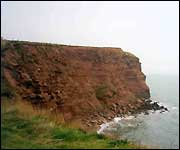 | | The cliffs at Budleigh Salterton |
The World Heritage Site designation prompted fears from conservationists that hordes of people would converge on the environmentally sensitive site, which stretches from Orcombe Rocks in Exmouth to Studland Bay in Dorset.
So local authorities - such as East Devon District Council, and Devon and Dorset county councils - have a real balancing act between attracting visitors and looking after the coastline.
The South West Coast Path gives people a great chance to take in the stunning views of the cliffs, and the official Jurassic Coast website - linked from this page - has information on where to go fossil-hunting.
These fossils are generally found in the Dorset section of the coast. But in East Devon, the prehistoric cliffs take in areas such as Budleigh Salterton, Branscombe, Beer and Seaton.
The way forward:
In September 2003, the Natural History Museum (NHM) released the results of a specially commissioned study on the way forward for the Jurassic Coast.
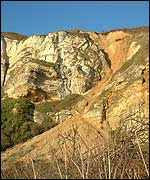 | | Evidence of a recent landslip at the cliffs in East Devon |
It took the NHM four months to complete the study, which pointed to the need as soon as possible for high quality interpretation centres in keeping with world class designation.
These would be in "gateway" towns and other key sites.
A single, major Jurassic Coast centre was also suggested for the longer term.
The museum's team said they were excited by the opportunities presented by the coastline's unique history.
But they said it was vital all the authorities along the 95 miles worked together to promote one Jurassic Coast, and not concentrate simply on the stretch in their area.
Director of Science at the Natural History Museum, Richard Lane, said: "The World Heritage designation is a tremendous opportunity for Devon and Dorset and for geological sciences.
"Through innovation of its interpretation, the Jurassic Coast can become a world leader in geological communication and education."
For more in-depth information, go to the Jurassic Coast website at: http://www.swgfl.org.uk/jurassic/
Article first published: 24th October 2003
| | | |
|
| | Weather |  | | Monthly statistics, features and information. |
| E-cards |  | | Send an e-postcard of glorious Devon to a friend. |
| In Pictures |  | | Browse through our vast selection of photo galleries. |

BBC Devon
Broadcasting House
Seymour Road
Plymouth
PL3 5BD
(+44) 01752 229201
devon.online@bbc.co.uk
|
|