|  | A new study carried out by the Devon-based Barn Owl Trust reveals the appalling death toll caused by road accidents.
The study - carried out over a 15 year period - shows that unless action is taken soon, the UK barn owl population is unlikely to recover.
The number of barn owls nationally has gone down by almost three-quarters (70%) since the 1930s - mainly because of intensive farming and developments on green field sites.
 | | Barn owls are a beautiful but increasingly rare sight |
There are now only 4,000 pairs left in the wild. Each year, they will produce 10,000 young owls, yet around 3,000 of those birds are being killed in road accidents.
In fact, half of all recorded deaths are road casualties.
Although the research by the trust was carried out in Devon, the results of the study are valid nationally.
The research found that: - As soon as a major road is opened, accidental deaths of barn owls begins.
- In the nesting season, from March to August, all adult barn owls whose nest site is within half a kilometer of a major road are almost certain to be killed.
- Road deaths have more impact on barn owls than any other creature.
- When young barn owls are dispersing from nest sites (August to November), around 40% if those within a kilometer of a major road will be killed.
The trust, based in Ashburton, is now calling for a complete end to new major roads being built in rural areas where barn owls are present within a 25km radius. This includes motorways, dual carriageways, and local bypasses.
Continuous three meter high screens of trees and hedges should also be provided alongside existing main roads, so barn owls can fly over the traffic.
The charity also wants to see more barn owl friendly habitat created on farms - but well away from main roads.
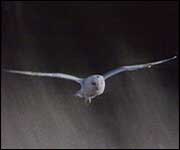 | | Barn owls are flying straight into danger |
David Ramsden from the trust said: "We've known for many years that barn owls are being killed on roads because we've been picking up the casualties.
"One of the really important findings is that the animals being killed in road accidents are those which would have lived; road accidents are killing those which have survived through their early life."
Another finding is that major roads are responsible for depleting barn owl numbers in almost half of the total area of rural England.
The 109-page report, compiled with the help of Professor Graham Martin of Birmingham University, has been sent to the Government, county councils and the Highways Agency.
Mr Ramsden hopes that now the hard facts are available, planning, farming and highways authorities must take the findings into account.
"I'm confident the report will make a difference, " he said. "It's another consideration for them, when looking at road builds."
However, he believes the other main problem - food supply - is going to be difficult to rectify.
"Food supply is the most important thing, but the difficulty is that the changes needed probably aren't going to happen.
"There's been an enormous amount of public funding pumped into agri-environment schemes, but the fact is that most farmland is still intensively managed.
"And in creating habitat which provides a food supply for barn owls, they've not really considered proximity to roads.
"This is the first major report, and one of the things which comes out clearly is that where such habitat can be provided, it should be away from major roads," he added.
Article first published: 10th November 2003
|