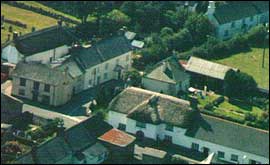
|  | Burrington is roughly 540ft above sea level and situated about a mile to the west of the beautiful Taw valley in North Devon.
It's a quiet village with a small Post Office & shop, a primary school, a thatched pub and a floodlit multi-use games area.
The centre of the village is dominated by the church, which is surrounded by older houses built mainly of cob, many of which date back to the early seventeenth century and were originally thatched.
There are numerous small businesses, both traditional and contemporary, located in and around the village including a micro-brewery!
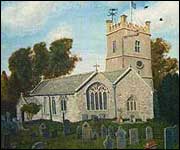 | | Holy Trinity Church |
Burrington Brewery, is the home of Newt Real Ales. It's a traditional brewhouse making real ales in the time honoured fashion using only the finest barley, malt, hops, water and yeast.
At present the brewery produces two beers - 'Black Newt', a porter style brew and a best bitter called 'Azza Newt'.
'Azza Newt' is on sale in the village pub, the Barnstaple Inn, where it goes under the name of Burrington Best Bitter.
The oak tree in the square is said to be about 500 years old, recent major surgery has given the tree a new lease of life.
In the 'Alphabet of Parishes' project, based at the Beaford Arts Centre, the village is represented by the letter O - for Oak.
A pottery plaque designed and made by local potter Harry Juniper, commemorating the centenary of the Parish Council and bearing a picture of the oak tree is displayed in the porch of the Parish Hall. Holy Trinity Church was built between 1150 and 1550 by the Abbot of Tavistock Abbey and cared for by those Benedictine monks until Henry VIII dissolved the monasteries.
The architect John Haywood extensively restored the building in 1869. The first incumbent was installed in 1277.
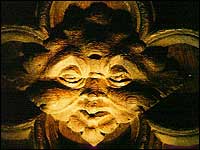 | | Hidden in the church - a Green Man |
The porch is 16th century; the door arch is much older. The door is of very heavy medieval oak with Tudor decoration.
Shot, which can be seen in the door, is said to be the result of Cromwell's muskets.
There is a Green Man above the door but it is usually in shade.
Outside, not far from the door, is a gargoyle waterspout - originally on the South East corner of the roof - this is 'leafy' - a Green Man.
Other Green Men can be seen inside the church. There is an 'impossible triangle' carving on the screen.
This must be a late addition as the triangle (also known as a Penrose Triangle) was first published in 1958 by Lionel Penrose, a British geneticist and his son Roger, a mathematician and physicist. 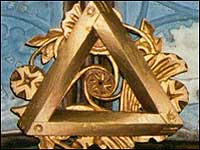 | | The Penrose Triangle |
Part of Burrington's entry in the Domesday Book [AD 1086] reads: "Bernintone / Bernintona / Bernurtona: Tavistock Church and William Cheever and Geoffrey from the Abbot. 28 goats."
There is no mention of a web site - presumably everyone knew that as the duck pond. We look forward to seeing you in Burrington - apart from the usual reason, which is 'lost'!
Article and photos by Dave Tylcoat, Burrington, 2003
Ewart W. Blackmore
Mr. Jeff Cox of Burrington has kindly solved my puzzle as to "Elscott". It is now known as "Aylescott",a farm owned by the SNELL family.Now to learn more about its history. Ewart W. Blackmore, Grimsby , Ontario, Canada
Dear Sirs; My ancestors worked at a place called ELSCOTT, Burrington but no one seems to have heard of it.Do you know what or where it could have been? Would it have been large enough to have been mentioned on a tour? William Wright, Hailsham, East Sussex
Hi, i really love the village of Burrington, my grandparents have recently moved to Leachlands Farm, and my brother and I came down to visit them last week. We were both really pleased to see that the village was so beautiful. On my return i wanted to find out more about the history of the village and found Dave's website which was very interesting. We went to the Barnstaple Inn and we were made too feel very welcome. I definately look forward to many more visits to Burrington, Will
|