|  | Barnstaple, the town on the Taw, is positioned on the first safe fording of the tidal river, six miles from the sea. It's immediately upstream of the tributary River Yeo, the waters of which, when added to the Taw's, made a channel too deep to cross, even at low tide. 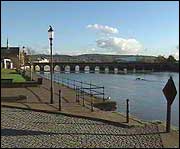 | The Long Bridge is one of the town's best known landmarks |
Barnstaple was built on the northern shore of the Taw, as the southern side was apt to flood on the spring tide.
The town evolved firstly as a Saxon burh (a fortified market town) and then later as a Norman garrison town with castle, baileys, town walls and gates.
The motte and bailey castle was erected over a Saxon graveyard on the western side of the town, thereby commanding the Saxon town to the east, the river crossings of the Taw to the south, the Yeo to the north.
Fighting ships:
Through the centuries Barnstaple's made its mark in history as the premier town of North Devon, a market town, a trading port, a manufacturer of woollen cloth (Barnstaple Beys), of terracotta pottery and silverware (there were silver mines in Combe Martin).
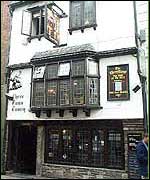 | The Three Tuns claims to be the oldest building in Barnstaple's main street |
In 1588, five fighting ships sailed to join Drake's fleet at Plymouth, ready to repel the Spanish Armada.
In the early 17th century Barnstaple was a popular port for merchants from elsewhere to base their America-bound trading ships, affording as it did an altogether safer route to the Atlantic.
Emigrants set sail from here: to America in the 17th and 18th centuries, and Australia in the 19th. Barnstable, Massachusetts (Cape Cod), was founded in 1639.  | more on Barnstaple |  |
|