| More from the Gambia on BBC Radio Devon | You can hear more about Danny's visit to The Gambia by clicking on the audio links on the right hand side or at the bottom of the page. His five reports examine aspects of life in The Gambia, and investigate how Gambian people are affected by traditional and contemporary ideas. You can also listen to Danny's programme Them And Us - a documentary looking at the relationship between Britain and the developing world. |
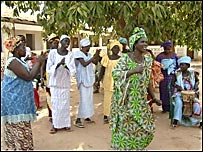
In Devon, the absence of a sizeable non-white, non-Christian community can create misunderstanding and prejudice towards Muslims, both here and in other parts of the world. An attack by 20 white males on a Muslim youngster in Plymouth's Central Park in July 2005 led to warnings to city Muslims to keep a low profile, for their own safety. The 2001 terrorist attacks on the World Trade Centre in New York and the 2005 London bombings have left a dangerous impression. Islam is quite different from the movement that emerged from North Africa in the 1950s. It's the Islamists, or Muslim Fundamentalists, though, who make the headlines. With Devon's Muslims making up less than one per cent of the population, a fair profile is difficult to achieve. A place like home?When BBC Radio Devon agreed that I could visit one of Britain's former colonies, The Gambia, I was keen to discover whether its predominant Islamic population was plagued by similar misunderstandings towards other faiths. 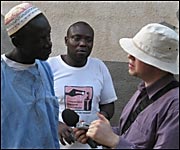 | | Danny Lawrence interviewing villagers |
Islam came to West Africa nearly 1,000 years ago, and the close-knit tribes held onto their religious heritage through centuries of European settlement, and British rule. When The Gambia gained independence in 1965, more than 90 per cent of the population was Muslim. Among the remainder are groups of Catholics and Methodists, each of whom bring British influence to The Gambia, through development aid. AcceptanceMarcel Badjie is the director of St Joseph's Family Farm, a Catholic-inspired community learning centre. He's a Christian, but dismisses any notion of segregation. "Here we love each other, we support each other, we give them whatever we can, regardless of what religion the other person belongs to." "You may be surprised as a visitor to come across families where some of the members belong to different religions, and yet it doesn't create any tension." "If you are a Gambian, you are a Gambian." IntegrationThe Methodist Mission also works actively within the Muslim community. Mama Manneh is an extension coordinator with their agricultural programme. 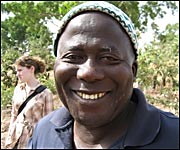 | | Mama Manneh from the Methodist Mission |
"They want to give self-autonomy to the Methodist branch in The Gambia", he explained. "At the moment, it's affiliated to London". He was appointed by the Methodist Mission in 1978 and has always been well received. "Up until now we have never operated in any Christian community. All the support is rendered to the Muslim communities." "This country is tolerant and the Mission is very, very tolerant, with a foresight for human development." And in the Methodist extension wing, they'll take everyone. Mama commented, "We have only one Christian, all the rest are Muslim. I am a Muslim." AppreciationVisiting The Gambia has certainly given me new perspective on how people of different faiths can live together without conflict. Coming from the predominantly white South West of England, where non-Christians struggle to find a place on the faith map, it was an honour to visit a place where the tables were turned. Because of my skin colour, Gambians could see I was different. And when I raised the matter of my being Christian, the reception seemed to become warmer. They're just grateful that someone takes an interest in them. In The Gambia, there's no time left for hatred. |