| 13 November 2014 |

| |
| BBC Homepage | | |
| |||
| Contact Us | | |
Nature FeaturesYou are in: Devon > Nature > Nature Features > Endangered bird seeks shelter in Devon 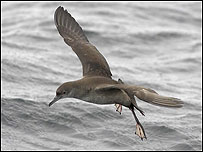 A balearic shearwater. Pic Bryan Thomas Endangered bird seeks shelter in DevonDevon's rocky coastline is becoming an important habitat for a globally threatened bird. A recent survey found a significant proportion of the world population of the Balearic shearwater at Berry Head. A globally threatened species of bird that uses South West coastal waters is to be formally surveyed for the first time. There are less than 2,000 pairs of the critically endangered Balearic shearwater remaining in the world, but they can be found in their hundreds each summer and autumn off the coast of Devon. The Royal Society for the Protection of Birds (RSPB) is co-ordinating a pilot study of the birds with the help of 'sea watchers' who have been monitoring them for many years. The sea watchers are a dedicated team of people who often get up to survey the birds at first light. They often have to brave strong winds, particularly from the south east and south west, which seem to attract the Balearic shearwater to our coasts. 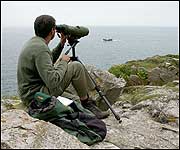 Seawatcher Mark Darlaston at Berry Head "Surveying Balearic shearwaters is a real challenge and has to be done by people who have some experience of looking for them," explained sea watcher Mark Darlaston. "To the untrained eye, they can be hard to identify amongst their cousins, Manx shearwaters, which are also in our waters at this time of year." The birds are most likely to be seen from headlands and the survey includes several locations in Devon including Berry Head, Seaton, Prawle Point, Dawlish Warren and Hartland Point. Breeding colonies can be found on only five islands in the Mediterranean – Mallorca, Minorca, Ibiza, Cabrera and Formentera – where the Balearic shearwater faces pressure from building developments and is at risk from being eaten by feral cats and rats. Once the breeding season is over, the birds head out of the Mediterranean into the Bay of Biscay and northwards, visiting the seas around Devon, Dorset and Cornwall - which conservationists believe will become increasingly more important for the species. RSPB conservation officer Helen Booker said: "These birds live and sleep out at sea, so their feeding habits and behaviour are poorly understood. "If we can observe them from land when they are here, we can hopefully determine what can be done to protect them in South West waters. 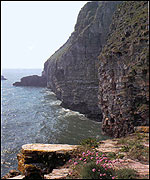 The cliffs at Berry Head "More than 100 were recorded off Berry Head in South Devon in just one day in September 2006 – which is a significant proportion of the world population." The pilot study of the birds, involving synchronised counts at different locations, will add to information gathered by the sea watchers and will hopefully provide a fuller picture of the life of the Balearic shearwater. Dr Russell Wynn of the National Oceanography Centre in Southampton is also studying the birds. "Balearic Shearwaters are venturing north to our coastal waters in increasing numbers, even though the species is declining and may become extinct within our lifetime," he explained. "I'm collaborating with oceanographers and biologists at the National Oceanography Centre to understand why they are moving north, and am working with the RSPB to expand the pilot survey next year." In 1991 there were thought to be a total of 3,300 breeding pairs of Balearic shearwaters, but since then it's estimated the population has decreased by more than a third. Based on this dramatic decline, the species is considered to be critically endangered on a global basis. It's the only critically endangered species which regularly visits the UK. A European Action Plan for the species has highlighted the lack of protection of breeding grounds in the Balearic Islands and also a threat from oil spills and limited food resources. Like their cousins, Manx shearwaters, Balearic shearwaters nest in burrows in the ground and only return to land at night to reduce their risk of being taken by their natural predators, such as large species of gull. Their nesting habits also make them vulnerable to being predated by rats and feral cats. last updated: 27/05/2009 at 16:55 SEE ALSOYou are in: Devon > Nature > Nature Features > Endangered bird seeks shelter in Devon   
| ||||||||||||||||||||
| | About the BBC | Help | Terms of Use | Privacy & Cookies Policy |