| 13 November 2014 |

| |
| BBC Homepage | | |
| |||
| Contact Us | | |
Nature FeaturesYou are in: Devon > Nature > Nature Features > Going batty in the Tamar Valley 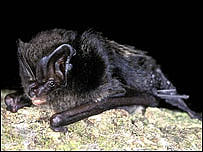 The very rare Barbastelle bat Going batty in the Tamar ValleyBritain's rarest bats have been discovered in a special survey of the lower Tamar Valley. Britain's rarest species of bat has been discovered in the lower Tamar Valley, along with seven other species, following a special investigation. Teams of up to four investigators roamed the woods and valleys at night, armed with bat detectors and radio tracking devices. They also tracked the bats to underground sites, venturing into mine shafts and tunnels, with the assistance of local cavers. The study was carried out as part of the Tamar Valley Mining Heritage Project, a £5.8 million Heritage Lottery funded scheme which plans to open up this part of the countryside to visitors. 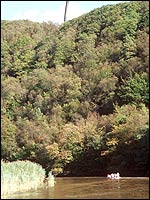 Bats have set up home in the Tamar Valley A total of eight bat species were recorded in the area, including Greater and Lesser Horseshoe, and Barbastelle bats - the rarest species in Britain. Other species identified included Long-eared, Daubenton's and Pipistrelle. Rosemary Teverson of the Tamar Valley AONB said: "The aim of the survey was to find out how the project area is used by bats, and in particular to establish the location of roost sites. "This is important so that future capital works such as building conservation and trail construction do not disturb or damage the bats. "We needed to know what species occur in the Tamar Valley, where they roost - summer and winter - and where they feed. "It will be vitally important that during the project we do not disturb these rare and fascinating creatures and money will be spent enhancing known sites and protecting open shafts with bat grilles." Bat sites were found in 26 structures including in ruins, chimneys, lime kilns, ore shutes and leat tunnels. Most were day roosts, where bats sleep, or night roosts where they rest between expeditions. 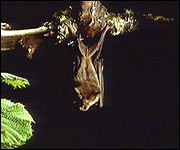 A Greater Horseshoe Bat The team ventured underground with the assistance of local cavers, and found a further 35 bat sites in mine shafts and tunnels, some up to half a kilometre from the entrance. Some of these are important winter hibernation sites. The survey was carried out as part of preparations for the Tamar Valley Mining Heritage project, which among other things will highlight the importance of local wildlife. The work was carried out by Greena Ecological Consultancy in East Devon, who are experienced in bat survey work. The main consultant, Geoff Billington, said: "The Tamar Valley is clearly an important area for these bat species. "It has a rare combination of secluded and undisturbed roost and hibernation sites due to the mining and unintensively farmed countryside providing foraging areas for food." The findings of this study will be used in planning future construction so the roosts are left undisturbed. The survey work complements an existing project being run by the Tamar Valley AONB Service, with funding from English Nature. Since 2004, a project officer has been visiting landowners in the area and advising them on managing farmland habitats for the Greater Horseshoe Bat. last updated: 22/08/2008 at 11:26 You are in: Devon > Nature > Nature Features > Going batty in the Tamar Valley   
| ||||||||||||||||||||
| | About the BBC | Help | Terms of Use | Privacy & Cookies Policy |