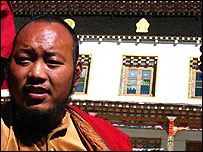
0100 HOURS, BATANG MEAN TIME.... I am enjoying the deepest of sleeps and the sweetest of dreams, when these three blokes come in, call themselves lamas: "TASHI DELE!" whispers the Chief Bloke, at about 156 decibels. ("Tashi dele" is Tibetan for "I say, how frightfully nice to see you old chap".) "Tashi dele," I reply, with as little enthusiasm as I can muster. Tibetan monks, or lamas (not to be confused with alpacas, which are smaller and have longer hair), as you probably know, go about their business in crimson robes. 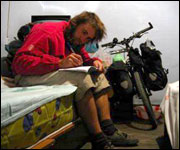 | | Edward in Batang |
What you may not know is what Tibetan monks wear UNDER their crimson robes. The answer, I am now in a position to divulge, is MORE crimson robes. I watched these gentlemen undress and the experience was much like playing pass-the-parcel with a Russian doll. Every layer of crimson robe that came off revealed another crimson-robed monk underneath, each one just a little smaller than the last. They went to bed, eventually, in crimson robe pyjamas, and at 0500 hours they got up and got dressed again, and asked me what time it was. I told them it was 0500 hours. On hearing this they re-de-robed and returned to bed until 0700, when they rose, robed (crimsonly), and left a second and final time. Bare Facts So much for Batang. I had to get to Baiyu which, as its name suggests, is a different place altogether. Opinions among the good burghers of Batang as to the existence of a road to Baiyu were divided. Some swore blind there was a road; others that there was not; yet others that there might be. Among those who professed the existence of a road, there was near unanimity that it was no more than a mule track and certainly not passable in winter on a bicycle. Now when "Terry the Tibetan" tells you a road is not passable on a bicycle this could mean one of several things. i) Terry's grandmother would not be able to cycle it.
or
ii) Terry doesn't think that a foreigner would be able to cycle it.
or
iii) Terry has recently bought a motorbike, and wouldn't be seen dead riding a bicycle even if the whole world were a billiard table.
or
iv) The road is not passable on a bicycle. The only way to discover the truth of the matter is to go and have a look for yourself. The bare facts are: Batang lies at around 2500 metres above sea level, Baiyu at 3200 metres. Between them are two passes well in excess of 4000 metres. And yes there is a road. Or a mule-track at any rate. | "Hello, I say in my best English. 'ello 'ello 'ello, says the Chinese policeman, in his best English. We are police. Oh, police-d to meet you, says I!" | | Edward's best knock, knock joke |
The first pass was snow-bound, and I had a hard time of it. Without the benefit of a motorbike track to follow, I would have had an even harder time of it. As it was I pushed, slipped and back-slid my way the final 16 kilometres to the pass in just under 5 hours. Terry's grandmother might not have made it! Coming down the other side, I lowered my saddle so that my feet were flat on the snow and acted as stabiliser-skis. (Don't try this at home!) Dead or alive? On the third day I camped just below the second pass, a beautiful spot by a half-frozen stream, with snowy peaks all around. At this point I succumbed finally, to a fit of paranoia brought on by the online rantings of Asmund, the Man In The Pink Gloves. (Those of you who follow my blog will know all about this, for those who don't; a quick summary: Asmund, a Norwegian by birth and by inclination, believes that for any Englishman who ventures outside the warm embrace of his home-and-castle, a lonely, glorious but futile, stiff-upper-lip sort of death is both certain and inevitable. This is what happened to Scott in the Antarctic, after all, and since the English persist in regarding Scott as a hero, despite his coming second and dying in the process, there is no reason to suppose that they have learnt any lessons. 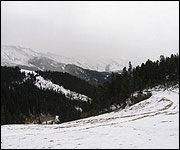 | | Snowy pass: lots more pictures on Edward's website |
And so Asmund spent most of the month of February (a short month, God be praised) writing long and imaginative accounts of how I, an Englishman, would die of altitude sickness and exposure and various other nasty things, and publishing these stories on my blog. Read more by clicking on the link on this page.) For now, let us return to me, the heroic but doomed English adventurer, lying in my tent that night just below the second pass on the Batang to Baiyu mule-track. Asmund's words began to bother me. A common feature of both altitude sickness and exposure is that the victim often does not realise he has a problem. As his core body temperature plummets, he feels pleasantly warm, and begins to remove his clothes; as his lungs fill with fluid and his brain swells, he feels as right as rain, and perhaps even a little righter. This can make self-diagnosis difficult. And so there I was, in my tent, somewhere up around 4000 metres, minus several degrees outside, and feeling really rather cosy - and as right as rain. Thanks to Asmund's exhaustive (I will not say exhausting) warnings, this overwhelming sense of wellness triggered panic. I became terrified of falling asleep, lest I never reawaken. Was I breathing normally? I held my breath to listen. I could hear nothing in the breathing department. Was I slurring my speech? I recorded something on my dictaphone - an "If you find this..." kind of message - and played it back. It sounded normal - but was my hearing playing tricks? I tried reading a couple of pages of Don Quixote to see if I could make sense of them - but was a book about a madman a good tool with which to test my rightness of mind? I kept myself awake till three in the morning, to see whether I was dying, but the longer I lay there, the 'weller' I felt. This was a bad sign. I tried reciting the names of the 50 states of the USA. Delaware, West Virginia, North Dakota, Maryland, La-la-land... right? I multiplied 647 by 891 in my head. That nearly killed me. I fell asleep, and woke up in a panic. I brushed my teeth. I felt so damned well that I was sure I was dying. Dawn came, and I boiled some noodles and honey to celebrate cheating death. Majestic Mountains Not long afterwards, I was at the pass, bedecked with colourful prayer flags and broken beer bottles. A pair of Tibetans turned up on a motorbike and I waited and watched to see what was the proper pass-passing ritual. They parked their bike, wandered over to the prayer flags, had a widdle and drove off again. 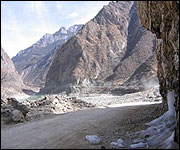 | | Majestic Mountains |
But the sky and the mountains and the eagles were majestic. And so I arrived in Baiyu, four days and something under 200 km after leaving Batang. And it came to pass that, as I lay curled up in my dormitory bed, I was woken by not one, not two, not three, not four, but five Tibetans knocking at my door. And yes, daylight come and they all go home - but not before they'd given me a night to remember. The dormitory contained six beds - mine and five others - of the narrow sort and into these remaining five, the five Tibetans tumbled - soon to be joined by three more. Now eight into five won't go, they tell you at school, but don't believe a word of it. These guys found a way. Which was fine and I had no objections beyond the rueful observation that the statistical probability of eight Tibetan room-mates all being non-snorers is lower than that of five Tibetan room-mates all being non-snorers. Oyez, Oyez! Snoring, it turned out, was not going to be my problem that night. Of the eight, six may have been librarians or food hygienists or agronomists or followers of some other quiet profession, but of the remaining two, it was my acute misfortune that one was a historian, and the other a town crier. The Historian set about discoursing for several hours, scarcely pausing for breath, until well beyond the hour at which histories are generally welcome. From the length of his narrative it can only have been the tale of his village, or more likely of the whole world, from the Very Earliest Times, not omitting some lengthy speculations on the Epochs Before Then. One or two of the other seven slept, or appeared to, but the rest of the crowd encouraged him in his disquisition, probing for for further details, clarifications and asides with occasional interjections and exhortations. The Historian's voice was steady and constant, not wholly unpleasant on the ear (or at least would not have been at some more reasonable hour, of which the day is blessed with several - and, indeed, plenty). The Town Crier, in contrast, had a voice well suited to his calling and trade, but less so to the manners and conventions of a hotel dormitory in that part of the night which God in his infinite wisdom and mercy has reserved for our most precious and profound sleep. But the Town Crier, devoted as he was to the practice of his most honourable and righteous profession, made frequent and voluble announcements throughout the night, as and when notions he judged worthy of such announcing came to him, which was often. Knock, knock. Who's there? Next day I moved to a different hotel, where I was paid a visit by the Boys in Blue (formerly the Boys in Green), guardians and upholders of the Queen's Peace in Baiyu. It went like this: A knock at the door. I open the door. A Chinese policeman is revealed, with a Chinese policewoman at his side. "Hello," I say, in my best English. "'ello 'ello 'ello," says the policeman, in his best English. "We are police." 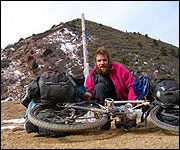 | | Preparing for the next leg of the journe |
"Oh, police-d to meet you," says I, and frankly I am so pleased with that one that I don't care if costs me 20 years hard labour. "Welcome to China!" says he, blanking my comic masterpiece completely. Probably because it isn't in the script they learn at Police Academy. As you can imagine, we got on tremendously well. He wanted to know where I was going, and how I proposed to get there. I said England, and by bicycle. The copper wrote this down in his little copper's notebook, and said to me, "You are crazy man. Good bye and welcome to China!" And with that, he left. |