Friday 25th November 2005 saw the first snow of winter - with heavy falls in many parts of Devon. Even worse, a combination of strong winds and very cold air brought a high wind chill factor, in simple terms it will feel bitterly cold. So the advice is to wrap up warm and only venture onto the roads if it's absolutely necessary. 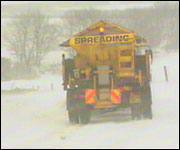 | | The wind and the temperature creates wind chill. |
But what exactly is a high wind chill factor? Anyone who's ever waited at a bus stop, or taken a walk on a blustery winter day, knows you feel colder when the wind blows. We call the cooling sensation caused by the combined effect of temperature and wind the wind chill. A chill wind doth blow On a calm day our bodies insulate us somewhat from the outside temperature by warming up a thin layer of air close to our skin, known as the boundary layer, so despite the recent frosts, it hasn't felt too bad because the winds have been light. When the wind blows it takes this protective layer away, exposing our skin to the outside air. It takes energy for our bodies to warm up a new layer and if each one keeps getting blown away, our skin temperature will drop and we will feel colder. Wind also makes you feel colder by evaporating any moisture on your skin, a process that draws more heat away from your body. Studies show that when your skin is wet it loses heat much faster than when it is dry. 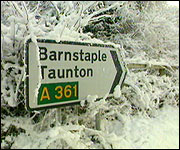 | | Could Devon see snow this winter? |
So wind chill is the chilling effect of the wind in combination with a low temperature. Humans do not sense the temperature of the air directly. When we feel that it is cold, we are actually sensing the temperature of our skin. Because our skin temperature is lower when it is windy (we lose heat from our skin faster than our body can warm it), we feel colder. Wind chill is described as a "feels-like" number. The old wind chill formula was based on experiments conducted in Antarctica in 1945 in which scientists measured how long a can of water hanging on a pole chilled during different combinations of wind and temperature. Wrap up warm Recently a new formula has been introduced, developed by representatives of seven government agencies, including the U.S. National Weather Service, the Canadian weather service and university scientists. 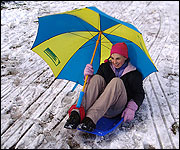 | | A brolly good time in the Devon snow. |
The new wind chill index is an attempt to measure the effect of combinations of low temperature and wind on humans or animals. When forecasters say "the wind chill is zero degrees," they are not saying the chilled object is cooled to zero degrees. A wind chill temperature is not some different kind of temperature, rather the effect it has on warm blooded animals. Theoretically the wind chill index is supposed to measure the rate at which the body loses heat when exposed to cold and wind.  | | South West weather forecaster David Braine. |
This index was created as a public health tool to reduce hypothermia, frostbite and other cold-related ailments. As a practical matter, the wind chill index is supposed to tell people how warmly to dress; a crucial decision for people who spend long periods of time outdoors such as fishermen and farmers. |