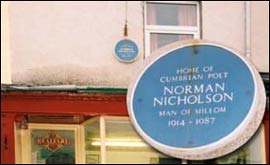
It was here in a Victorian terrace that Norman Nicholson was born in 1914 and lived most of his life. And if you read the works of Cumbrias most influential Twentieth Century poet prepare yourself for more than just pretty lakes and fells; youll be just as likely to find a field of weeds or a decaying ironworks because Norman Nicholson wrote about every aspect of the county he lived in. 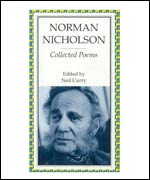 | | The sleeve of Norman Nicholson, Collective Poems Edited by Neil Curry |
And he understood the how the complex puzzle of jigsaw pieces that make up Cumbria fits together, how the rock that lies under our feet and forms the high fells is the same rock that put the bread on the table for thousands of families through the mines and quarries and ironworks. He points out in flowing, easy to understand language how towns and villages like Appleby and Seascale are built out of the very rock that they sit on. His writing about the power and timelessness of rock and the presence of the hills is as good as youll find anywhere, if not the best. 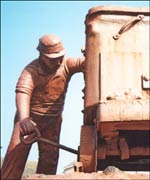 | | Statue of a Hodbarrow Miner in Millom town centre |
Its hardly surprising that Norman Nicholson was inspired by industry. Millom, his home town was one of the busiest iron ore mining areas in Europe during the late 1800s, and the whole of South and West Cumbria was peppered with quarries, mines and furnaces for smelting the iron ore. Norman wrote about the toughness of life for the folks who worked in industry, the grime, the sheer physical hard work and the almost regular tragedy like when his own uncle Jack was killed in the huge Hodbarrow mines at Millom. Its a million miles from hosts of golden daffodils but this is robust writing about real Cumbria and all powerful stuff. 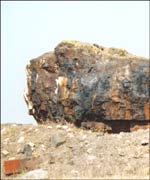 | | Milloms last iron, the final remnant of a thriving iron industry sits on the site of the dismantled ironworks. |
Of course the history of industry in Cumbria is now the history of industrial decline. Norman saw the thriving Millom ironworks go from boom to bust in his lifetime. The business that employed nearly all of the town closed in the mid 60s and he saw the dole queues snaking down the street, he saw what happens to men when they lose their jobs and their pride, he saw what happens to a town when you rip the heart out of it he put it all down on paper. Norman wrote about what he saw around him but the poems were about more than that; for him, his writing was about the relationship of people to the world around them and his work was about universal subjects that were as important whether you lived in Millom, Mexico or Madras. 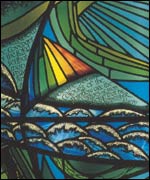 | | Memorial window |
If you go to St Georges Church in Millom youll find a specially commissioned stained glass window designed and made by Christine Boyce. Its inspired by Normans poetry and its really worth a look. Sadly some of his work is out of print now but you might be able to find it in second-hand bookshops or via the internet, but there is a good collected works published by Faber and Faber and edited by Neil Curry. Take a look and steep yourself in Cumbria, past present and future! Your comments Norman Nicholson - you're right "The Collected Works" is out of print and there is only one copy currently on offer thur Amazon and it's £82. Someone needs to persuade Faber + Faber to re-print. Wendy Cook |