 |  | Review by site user Charles Lloyd
While British commercial cinema continues to struggle, the contemporary art market has recently embraced film as both subject matter and medium of choice.
In this context, the opportunity to hear a contemporary abstract painter discuss the influence of film on her work seemed promising.
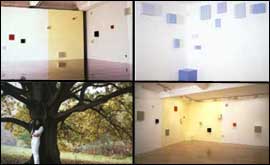
The artist in question was Yuko Shiraishi, whose work was on show at the Mead Gallery, Warwick Arts Centre, under the title Episode, and the film screened was Andrei Tarkovskyís masterpiece Andrei Rublev.
Also installed in the gallery, in an adjacent exhibition curated by Shiraishi, are a number of photographs by well-known photographers - more of the artist's influences.
Shiraishi's colourful canvases, however, being abstract paintings, do not contain any formal or narrative elements drawn from the Tarkovsky film or the photographs. The influence, we are led to believe, is deeper than that.
Andrei Rublev tells the epic story of a 15th century Russian icon-painter.
It is an extraordinary film, both in its imagery and narrative form and in an age of Hollywood blockbusters it is also rarely screened.
In discussion with Natasha Synessios, a Tarkovsky scholar, Shiraishi clearly demonstrated a deep love for Andrei Rublev.
It was also evident that the basis of the film's influence lay in Shiraishi's personal identification with certain of the characters and themes, the difficulties and dangers involved in making works of art, for example.
For an event entitled Examining Influences, this was sorely disappointing. Identifying with the characters and events of a film is a commonplace and it tells us nothing about Shiraishi's method of working as a visual artist.
Though she once called Andrei Rublev her "Bible", Shiraishi articulated little more than appreciation for the struggles of the protagonist and this lack of real dialogue between Shiraishi's work and her stated influence was perplexing.
Similarly, questions from the audience seemed to observe a strict division between those relating to Suraishií painting and those interested in eliciting more from Natasha Synessios on Tarkovsky's film.
In the end, the art/film interface was never really explored and the premise of the event, examining influence, never materialised in any substance.
|