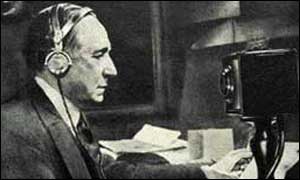
It was 100 years ago that the first trans-Atlantic wireless signal was sent and received. Many believe Guglielmo Marconi was the pioneer of wireless, bringing all parts of the world together. Marconi's project in Poldhu, Cornwall led him to become the first person to bridge the Atlantic by wireless. It was a massive financial gamble finally costing £50,000, an enormous sum at the time. Many scientists believed the curvature of the earth would prevent wireless waves, travelling in straight lines, from spanning the Atlantic. Marconi set out to prove this was not the case. 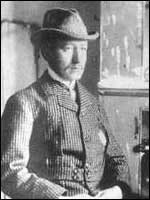 | | A well respected genius |
He chose sites at Poldhu and Cape Cod in Masachusetts. Later Glace Bay in Canada would be chosen. In September 1901 the 200 feet aerial masts, which were erected at Poldhu, were blown down in a storm. Despite this setback Marconi continued. A temporary aerial was erected. He agreed to replace the system of masts with a permanent structure of four wooden towers. It was decided transmission should be attempted to the nearest landfall on the American continent. This was Newfoundland. Marconi set sail with two assistants in November 1901. The colonial government of Newfoundland offered him assistance and he was loaned premises at Signal Hill in St John's to set up his equipment. 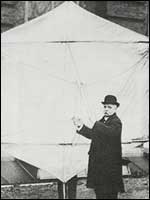 | | Marconi's experiment involved kites |
On December 11 the first attempt at transmission from Poldhu took place. A weak signal was received but disaster struck when the strong wind caused the balloon that was holding the aerial aloft to be lost. But Marconi was not giving up now he had come so far. On December 12, after losing one kite, a second was launched with the aerial attached and a signal from Poldhu was heard unmistakably by Marconi and his assistant Kemp. "The chief question was whether wireless waves would be stopped by the curvature of the earth. All along I had been convinced that this was not so. The first and final answer came at 12:30 when I heard ... dot ... dot ... dot" - Marconi The British press of the time may have been sceptical but the Canadian government hailed Marconi as a benefactor. They offered him land plus £16,000 towards the building of a wireless station there. In New York he was honoured by the American Institute of Electrical Engineers. Alexander Graham Bell and Thomas Eddison both personally honoured Guglielmo Marconi. Read about Marconi's life. |