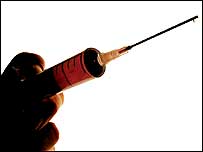
Millions of people die because hundreds of millions of dollars worth of life-saving vaccines go off and are thrown away every year. Hot third world countries, where they're needed most, are hit the hardest. Imagine the difference it would make if we could solve the problem. Cambridge scientist Dr Bruce Roser has devoted his life to it, and in our exclusive special report, Anthony Bartram has the remarkable story behind the science set to change the world. 10 million more lives could be saved if half of all vaccines - 300 million dollars worth - didn't have to be thrown away each year because they go off or are contaminated in the field. For years the World Health Organisation's been looking for a stable vaccine - Dr Bruce Roser believes he's found it. "Millions of children around the world now have much better prospects. Stable Liquid Technology enables vaccines to be stored without refrigeration, giving them a very long shelf life and enabling children from all areas of the world to receive cheaper and safer immunisation from preventable killer diseases." The science is new but it's based on a natural phenomenon billions of years old. A desert flower called the Resurrection Plant can lie in a state of suspended animation for a hundred years or more. Its molecules are trapped in a soluble glass which come alive when it rains. Dr Roser's company Cambridge Biostability has replicated the process, heating and drying vaccines into a powder, which is actually tiny glass micro-spheres with the vaccine trapped inside. Tests have shown it's completely stable after six months stored at 55 degrees Celsius. "The trick is the suspension fluid is the same density as the micro-spheres. You can have it in the glove compartment of your Land Rover in the desert and it's ready to use. The suspension fluid itself is totally bio-compatible and is simply breathed out naturally within minutes of the vaccination." Dr Roser began his quest at Anglia Polytechnic University in Cambridge before setting up the biotech company in 1998. Now his team believe they're within touching distance of delivering the "Holy Grail" to the international vaccine programme... Shevanti Sen is in charge of research and development. "Unicef and the WHO (World Health Organisation) have been crying out for this technology for years. We have bench-tested it in the lab and with new major funding we just need to keep the momentum going to get it out there." Testing should be completed with funding announced today by the Department of International Development. The Biostability vaccine's impact should be felt in India first within 3 years. Also, by developing a device so that anyone can inject the vaccine, another major issue has been tackled. By 2010, 130 million children will be born each year which means the World Health Organisation will need to deliver 3.5 billion vaccinations a year, and they simply don't have enough trained healthcare specialists to do it the old fashioned way. We'll also feel the benefit at home. The stable technology makes it possible to mix different vaccines into a single shot. Dr Roser has his eyes fixed firmly on the future, the next step it to control the rate at which the microspheres dissolve to delay the release of vaccines into the system; "The aim is to have a single shot multi-valent vaccine which can immunise against all life-threatening diseases for a life-time, there wouldn't even be a need for boosters." Rt Hon Hilary Benn will announce the DFID support for the groundbreaking technology at the Royal Society of Medicine Headquarters in London on Tuesday 19th October 2004. |