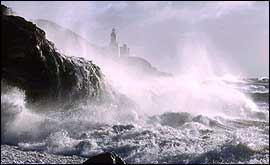
With mean winds of 150 MPH, gusts of 200 MPH, up to 30 mm of rainfall and tidal waves 5 metres high ensure there’s no doubting the destructive powers of hurricanes. They can cost us dear both in financial and human terms. Hurricane Andrew caused more the $30 million damage caused in Florida in 1992. And the Galveston Hurricane of 1900 was responsible for the death of around 10000 people. Hurricanes form over very warm tropical waters, close to the equator. Our bad weather systems - or depressions - form off the eastern seaboard of North America and are totally different in character - no matter how windy it gets. So remember - we don’t get hurricanes in this country - as Michael Fish pointed out one fateful evening back in October 1987…. But what Michael did not have time to make clear, is that although we don’t get hurricanes in the West Country, we can get hurricane force winds. What was later to become known as the Great Storm was being referred to on the 15th and 16th October 1987 as a Hurricane. With damage on the scale that occurred that day it is easy to see how the distinction between a storm and a hurricane can be lost. But in fact any wind above 73 MPH is of hurricane force. And once winds become that strong then damage can be spectacular. The West Country was lucky to have missed the worst of the Great Storm with the south coast, Southeast and East Anglia taking the brunt of the Storm. But damage was still pretty severe in our region and our reporters were struggling manfully to bring us details of what was happening. Hurricane force winds can cause major problems in the West Country and they do so on a fairly regular basis. But we should all be very grateful that the worst that Mother Nature throws at us is a depression. Now if it was a hurricane, that would be a very different matter. |