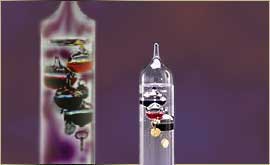
He realised that the density of a liquid changes with the temperature. That’s why, in the thermometer named after him, as the temperature rises and the density of the liquid in this tube decreases, differently weighted glass globes sink to the bottom of the tube. Each globe corresponds to a different temperature, but what temperature scale should we use? If only Galileo knew what what a can of worms he had opened! Gabriel Fahrenheit was a German. He devised his temperature scale about 300 years ago. On the Fahrenheit scale water boils at 212 degrees and freezes at 32 degrees. And therein lies the problem - these are not easy numbers to deal with. Step forward Anders Celsius, a Swede, who was a contemporary of Fahrenheit. His scale used 0 and 100 degrees as his reference point and this scale was the one that became established. In fact it has been universally recognised for over fifty years. So why is this scale not universally accepted? A lot of older people - like David Garmston for example - are used to Fahrenheit. The media love Fahrenheit in hot weather. ‘Scorchio! - temperatures hit the nineties’ is a great headline - far better than ‘Temperatures in the twenties’ with Celsius. But almost everyone under 40 was taught Celsius at school and - by definition - it is easier to use. When the weather turns colder Celsius winds hands. Zero is much easier to understand than 32 when the thermometer plunges to freezing. So when you hear me talking about degrees Celsius - it’s not some directive from Brussels that I’m following. It is the recognised scale. And if you’re still struggling with Celsius after all this time then just remember…. Five, ten and twenty one, winter, spring and summer sun. We may use hi-tec remote sensors for measuring temperatures these days and the Galileo thermometer is now nothing but an attractive curiosity but there is a quite a history behind the development of temperature and temperature measurement. And it all began with Fahrenheit, Celsius and Galileo. |