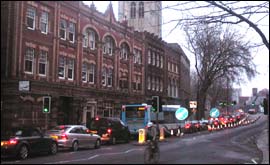
So what we doing to relieve it? There are three major plans to cut the traffic in the city: congestion charging; 'showcase' bus lanes and a new tram. The aim is to combine the stick-and-carrot approach to get people out of their cars and onto public transport which they actively want to use. What's in the pipeline? Well, after many years of wrangling, the supertram will now run from the city centre to Parkway but not - for reasons of cost - to Cribbs Causeway as South Gloucestershire County Council had wanted. Pat Hockey, executive member for South Gloucestershire Council for planning, transport and strategic environment, says an alternative to the tram is now a priority. "Bradley Stoke and the employment areas at Cribbs Causeway and Aztec West need to be covered," she told the BBC Bristol website.
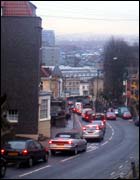
One of the city's hotspots, on St Michaels Hill |
"Plus there is 2,000 strong housing development - and businesses - planned next to Cribbs Causeway which will have to be served," she said. The big drawback of the tram is that it will not be in place before 2007.
Bristol City Council says this timescale will give people a chance to comment on - and get used to - the idea. After 2007, the council says it will look at introducing congestion charges at peak times for entry into an inner ring road.
It says this should cut rush hour traffic but still attract shoppers and visitors. This is something local residents will definitely need time to get used to, especially if the charge is £6, as recently reported. In a recent RAC survey, only 24% of people polled in the South West, Midlands and Wales supported the introduction of road charges. All eyes are on the London project but not everyone - including the local Automobile Association (AA) - is convinced that charging will reduce as much traffic as desired. The big problem with the tram and congestion charging is the timescale.
Bristol does need a long-term approach, but it also needs a quick-fix if people are ever going to believe public transport is the answer. Side-by-side with these initiatives sits the showcase bus routes: designated bus lanes aimed at 'queue relocation'. There are three planned in Bristol: in order, the A38 on Gloucester road - now given the go-ahead - eventually linking up with Thornbury, the A420 from Kingswood and finally, the A432 corridor from Yates. | YOUR VIEW |  | | Bristol's traffic | | | What would you do to solve Bristol's traffic problem? Is the tram the solution, or will congestion charging help? | |  |  Talk Bristol Talk Bristol |
The idea is that the council provides the lanes, and First provides more low-deck buses and better information for passengers. The problem - as always with buses - is convincing people that they are reliable and cost-effective.
AA Spokesperson for the West Country, Alison Birkett, adds: "We have among the lowest public transport subsidies - and the highest bus and tram fares - in Europe.
"So people are paying over the odds for the worst service." South Gloucestershire council also admits it is just firefighting on its bus network - instead of subsidising new routes - as the bus companies struggle to get the drivers and close unprofitable routes.
In a vicious circle, long-term strategic planning becomes much harder under these circumstances. Other initiatives being considered by the city council are better park and ride facilities, home zones, more road safety schemes and cycling initiatives.
South Gloucestershire Council also wants to extend its multi-occupancy lanes onto the ring road, rewarding drivers who regularly participate. There are also a number of road projects planned by the Highways Agency in the region: - Message boards on the M5 to better inform motorists of traffic jams.
- Three climbing lanes for the M5; north and south of Avonmouth bridge and one north of Clevedon.
- Plans for a climbing and diverge lane on junction 18 of the M4 heading east.
|
In the eyes of some, people need a stick to nudge them onto public transport - particularly the school runners, one of the single biggest causes of traffic congestion in any city.
The big problem is that - at the moment - there is just no real 'carrot' to back this up. Attitudes of people in the city need to change but without better choice, citizens and commuters will find this difficult.
What do you think?
Discuss the city's traffic issues in Talk Bristol. |