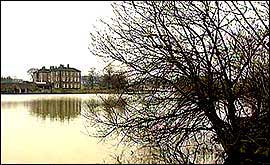
Walton Hall, near Wakefield, was the home to Charles Waterton, a naturalist who in the early nineteenth century travelled the world collecting rare species and, on his return, created the world's first nature reserve here in West Yorkshire. 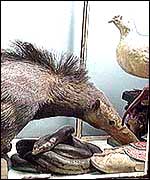 | | The animals Waterton collected on his travels can now be seen at Wakefield Museum |
This would be enough to make anybody famous - Waterton Lakes, one of Canada's National Parks is named after him - but Waterton was also an eccentric and a taxidermist. After his travels, Charles Waterton enclosed 250 acres at his home with an eight-foot high wall which ran three miles.
Although he fought invasions from poachers and industrialists, he opened his land to the public so they could enjoy the wildfowl sanctuary he had created. Inside Walton Hall he displayed the animals he collected while travelling and these are now on display at Wakefield Museum. Here you can not only see the specimens of rare species he brought back to England, still in their original cases, but you can follow his journey through South America.
From a small boy, Waterton was fascinated by animals - he was even made the rat-catcher while he was at school. He was happiest when he was chasing around, climbing trees and collecting birds eggs. 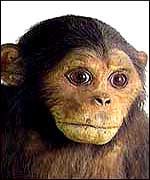 | | Squire Waterton's specimens wanted his specimens to look lifelike |
Waterton developed his own system of taxidermy. Having seen specimens in museums and other private collections he decided, based on close observation, that he could do a better job and all of his specimens are hollow.
He famously told a visitor to his house: "Allow me to inform you that there are no stuffed animals in this house." He used mercuric chloride to prevent deterioration and would adjust the dead animal until it was lifelike. His collection has survived in very good condition. Despite his belief in close observation Waterton also combined parts of different species to create his own grotesque imaginary specimens. His Nondescript is said to have been a likeness to the Treasury Secretary of the day.
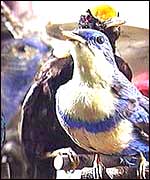 | | These birds still show their fantastic colours today |
He was a Catholic and so a monkey with horns and a grin became Martin Luther After His Fall. In another grotesque a porcupine (below) is made to appear weighed down by the national debt. It is said that Waterton once climbed to the top of St Peter's in Rome and it is known that he continued to climb trees right up to his death in 1865. Today Walton Hall is a hotel, conference and leisure centre and the Park is a golf course although there are several public footpaths. However, you can visit the Waterton Countryside Discovery Centre nearby where you can enjoy interactive displays and even meet the Squire's ghost. 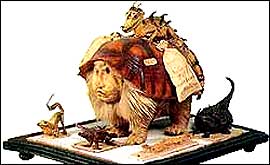
"John Bull and the National Debt"
(c) Wakefield MDC Museum and Arts
|