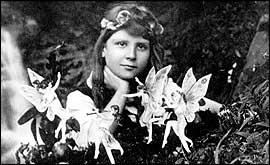
One Saturday afternoon in 1917 two Bradford cousins, 10-year old Frances Griffiths and 17-year old Elsie Wright, went out into the garden with Elsie's father's camera. On their return they claimed they had seen fairies at the bottom of the garden next to Cottingley Beck and they had even photographed them! 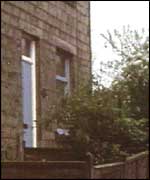 | | It was in the garden of this house that the "fairies" were photographed |
The images captured on camera by the girls showed images of fairies dancing. Could it be that now there was real evidence that fairies existed, captured right here in Bradford? Perhaps the world would never have known about the Cottingley fairies but in 1920 Sir Arthur Conan Doyle, creator of detective Sherlock Holmes, not only wrote about the existence of the photos in Strand Magazine but declared them to be authentic. Would Holmes and Watson have been so convinced? 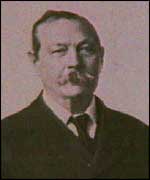 | | Sir Arthur Conan Doyle |
Throughout her life Frances always maintained the fairies were real but five years before her death Elsie Wright decided to come clean. Speaking on the BBC programme Nationwide in 1983 Elsie explained: "At that time women wore great big pinwheel hats, you know, with great big crowns and they have to take their hat pins about this long." If fashions had been different then there may well have been no Cottingley fairies. 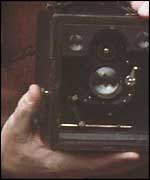 | | Elsie father's camera. |
Elsie father's camera has found a home in Bradford's National Museum of Photography, Film and Television. Colin Harding, the museum's Curator of Photographic Technology, says: "Elsie wrote letters to the Yorkshire Post, where she finally admitted these were fake, that they were paper cut-outs mounted on to twigs using hat pins and then rephotographed but Frances all along maintained while some of the photos were fakes some of them were indeed real photographs." Maurice Atack's mother went to school with Elsie Wright in Cottingley but he thinks the whole thing was a fake although he does think the girls helped put Cottingley on the map: "My mother came to school with her and she used to draw fairies all over her exercise book so she was very artistic accept what Elsie Wright said in later life. They were cut out of paper and stuck on hat pins and out into the trees and no-one could see just how they were done. 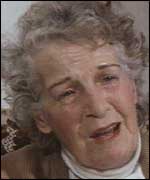 | | Elsie Wright speaking on the BBC programme Nationwide in 1983 |
"The older people used to call the village Fairyland. Even the bus conductors used to say, when they got to Cottingley Bar, 'Fairyland' for people getting off the bus
" Margaret Krupa, who is also from Cottingley, thinks the fairies may have existed: "I would like to think there are fairies. We've all got the child in us, haven't we? At heart we're still children even though I am over 60. I would hope that the fairies were there at some stage. My mother knew Elsie Wright. Elsie was older than my mother and she always thought she was a bit strange, perhaps a bit yonderly. I think (she was on) on another plane to everybody else so she may have had some sort of psychic powers that other people didn't have." 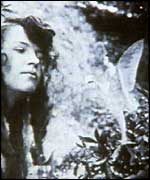 | | Frances Griffiths always said the fairies were real... |
Margaret does not accept Elsie's explanation: "I think it would be very, very difficult to photo fairies on hat pins without something showing."
Colin Harding adds: " I think the thing to bear in mind, of course, was that whether or not the photos are fake it doesn't affect the notion of whether fairies may, or may not be, real." But, despite Elsie's confession, people still seem fascinated by the story of the Cottingley fairies. Just a few years ago movie stars, including Harvey Keitel and Peter O'Toole, and film crews descended on West Yorkshire to film Fairy Tale: A True Story. But, perhaps, we should listen to Conan Doyle's contemporary J.M Barrie who wrote in his famous novel Peter Pan: "Every time you say you don't believe in fairies, a fairy dies."
Spencer Stokes interviewed Maurice Attack, Margaret Crouper and Colin Harding for BBC Radio Leeds' Weird West Yorkshire Week. |